TAG STORY · JOURNAL
The Day I Almost Walked Away From a Hackathon
From maritime navigation to Fetscape: some things only become clear once you start.
TAG Story ·
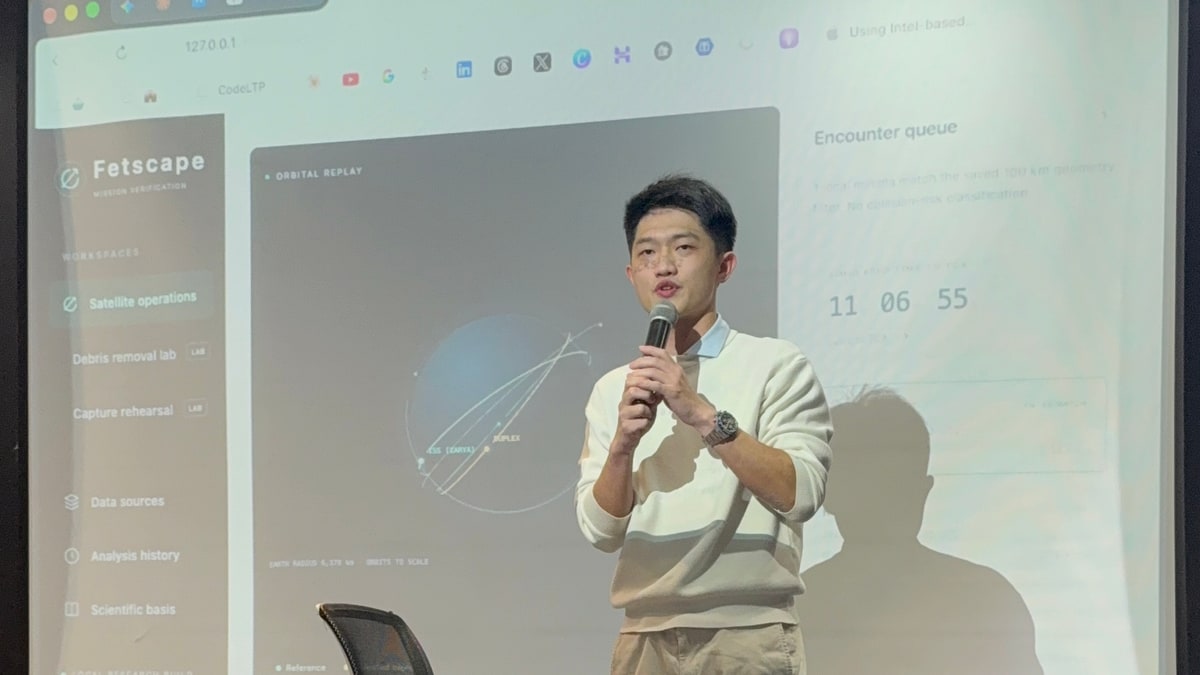
Before walking into the hackathon venue, I seriously considered going straight home.
Nobody would know I hadn't participated. No stage, no explaining my work, no public record of failure. It was an easy choice to justify.
The only problem was that I would know.
I went in, carrying my nerves and a space idea I didn't fully understand myself.
From Maritime Navigation to Unfamiliar Space
My interest in aerospace goes back to 2024, when I was applying to the MIT Bootcamp. My background is actually in maritime navigation. I've worked with radar, navigational systems, and the fundamentals of tracking moving objects at sea. On watch, you need to judge how another object is moving, how trustworthy the information is, and how much time you have to respond.
Those questions made me curious about space. But maritime experience does not automatically become aerospace expertise. Ships respond to currents, wind, and their hulls; satellites move in orbits dominated by gravity. Predictions can also be affected by Earth's gravity field, atmospheric drag, and other factors. You cannot simply transfer collision-avoidance methods from the sea to space. NASA's explanation of orbital design
What I could bring was a sensitivity to relative motion and uncertainty. The rest I had to learn again.
For almost a week before the event, I kept thinking about what to build. I considered different directions without settling on one. Eventually, a question connected them: could I combine what I knew about navigation with AI and try building something for the space industry?
I started reading about satellite collision avoidance and orbital debris. The papers covered orbital mechanics, relative velocities, coordinate systems, and math I wasn't sure I understood even after reading it. The more I researched, the more questions I had.
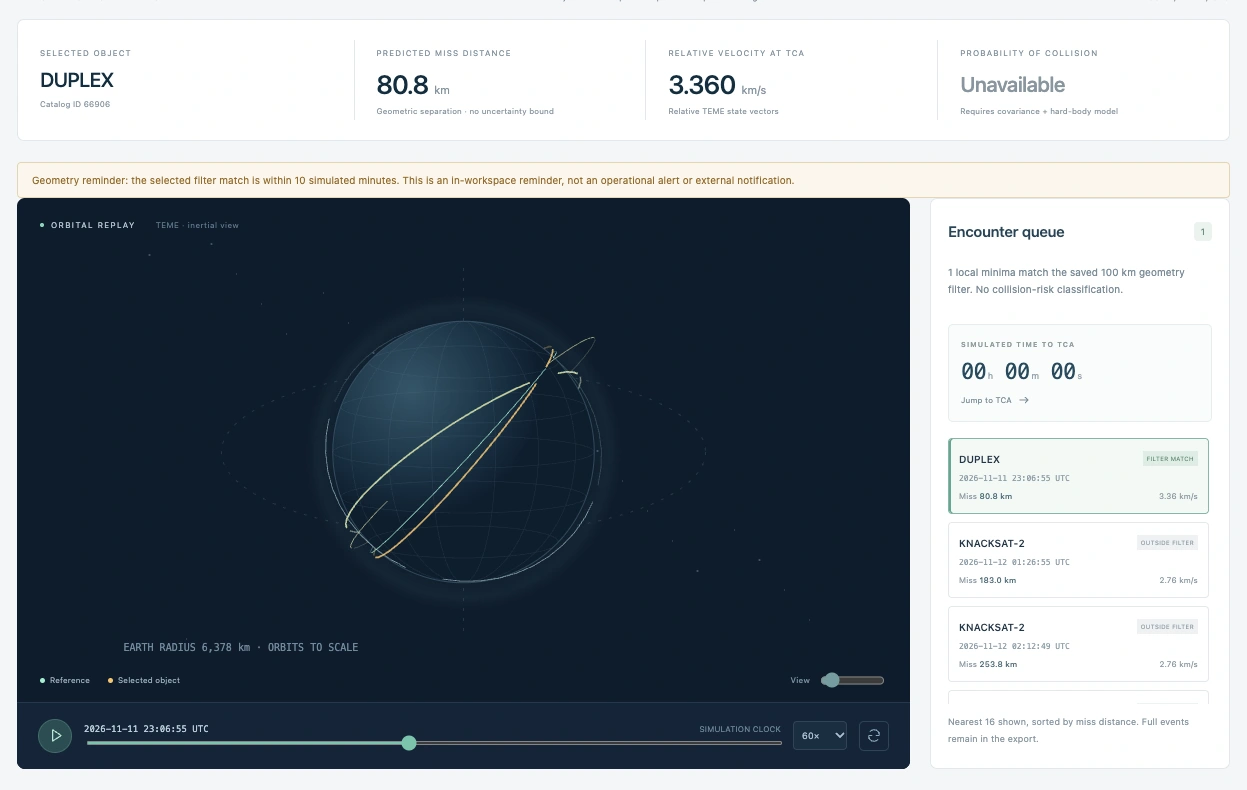
For example, two paths crossing on a screen does not mean the objects reach the intersection at the same time. Even after calculating the time and distance of closest approach, estimating collision probability requires knowing positional uncertainty and object size. Distance is a geometric result, not a complete assessment of risk. ESA's explanation of collision risk assessment, §1.3
Making the Problem Small Enough to Start
I originally wanted to build a satellite collision-warning or avoidance system. By this point, I could see more clearly that it was not something I could responsibly complete in four hours.
So I narrowed the project to a conceptual rehearsal for collecting space debris: first explore orbital motion, then let users operate a fictional cleanup vehicle to see how approach, alignment, and capture might be presented. That became Fetscape.
With a smaller scope, I could finally explain what I intended to finish: a software prototype people could operate and use to examine assumptions, rather than a system deciding a real satellite's next maneuver.
I had researched data and tried tools before the competition; at the venue, I continued rebuilding and integrating. Using Codex, I separated work on orbital calculations, the interface, data, and business research, prepared 3D assets separately, then brought everything into one demo.
The interface uses TypeScript, React, and Vite. A local backend built with Node.js, Fastify, and SQLite handles computation services and records. Shared data formats let an analysis be traced from its input through the calculation to the screen.
Orbital values are computed with satellite.js's SGP4 model. It converts applicable orbital parameters into positions and velocities at specified times, after which the program searches for the closest approach between two objects. AI helped develop the software; it did not replace a mathematical model by guessing where satellites were. Fetscape's calculation methods
The capture scene uses a different model. I imported Meshy assets, processed them in Blender into browser-loadable GLB files, and displayed them with Three.js. The original assets had no skeletal animation. Joints, pivots, and motion sequences still needed to be configured before the collector and robotic arm could move.
I can switch views, approach a target, start capture, or abort and retreat. But the scene's movement and locking remain simplified rehearsals. They do not validate real contact forces, sensors, or momentum exchange after capture. Orbital analysis, the thrust-degradation study, and the capture scene also use separate models. Putting them in one interface does not make them a complete, reliable space system.
AI shortened the cycle of research, coding, and revision. It did not remove those boundaries. Running code and passing tests are different questions from actually carrying out a mission.
Three Models, One Interface
Three independent paths | Input → Model → Output |
|---|---|
01 | Public GP / TLE orbital parameters |
02 | Synthetic measurements and thrust faults |
03 | GLB concept models and synthetic state |
Each path answers a different question. Displaying them together does not establish a validated, integrated flight-control system.
Two and a Half Hours on the Screen
As I remember it, about two and a half hours into that evening's work, we had a version we could demonstrate.
The cleanup vehicle, target, and controls finally shared a screen. Something that had existed only in my imagination was suddenly right in front of me. I could change the viewpoint, adjust the approach, and see how the scene responded. An idea I had only been able to explain in words was taking a form I could point to and change.
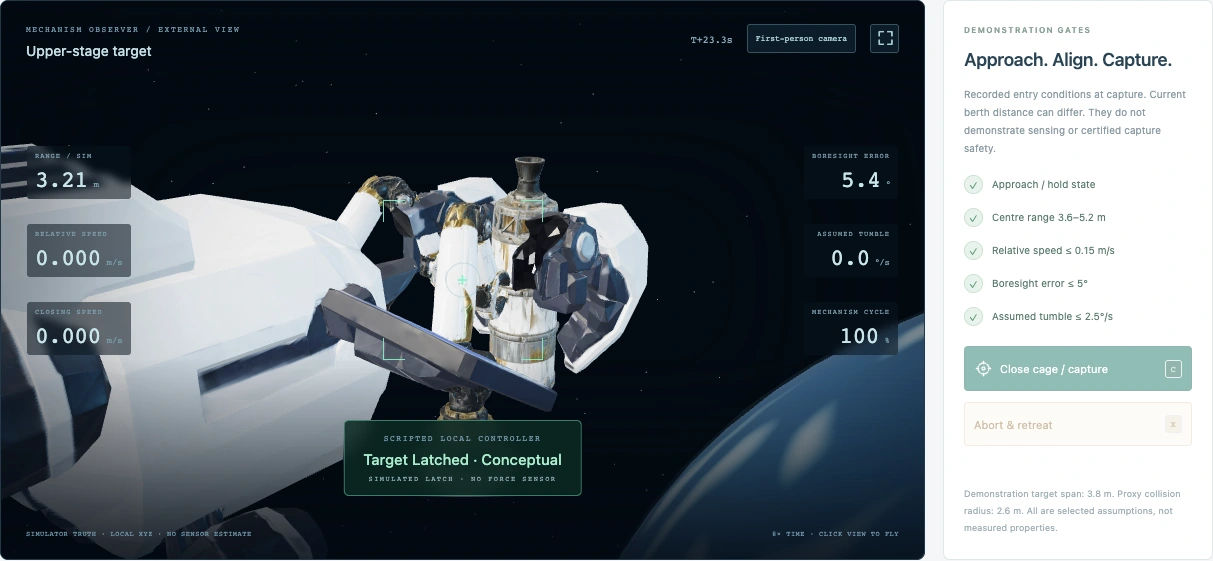
That moment felt great. The problems were far from solved, but I could begin to see what I was actually asking and what was still missing.
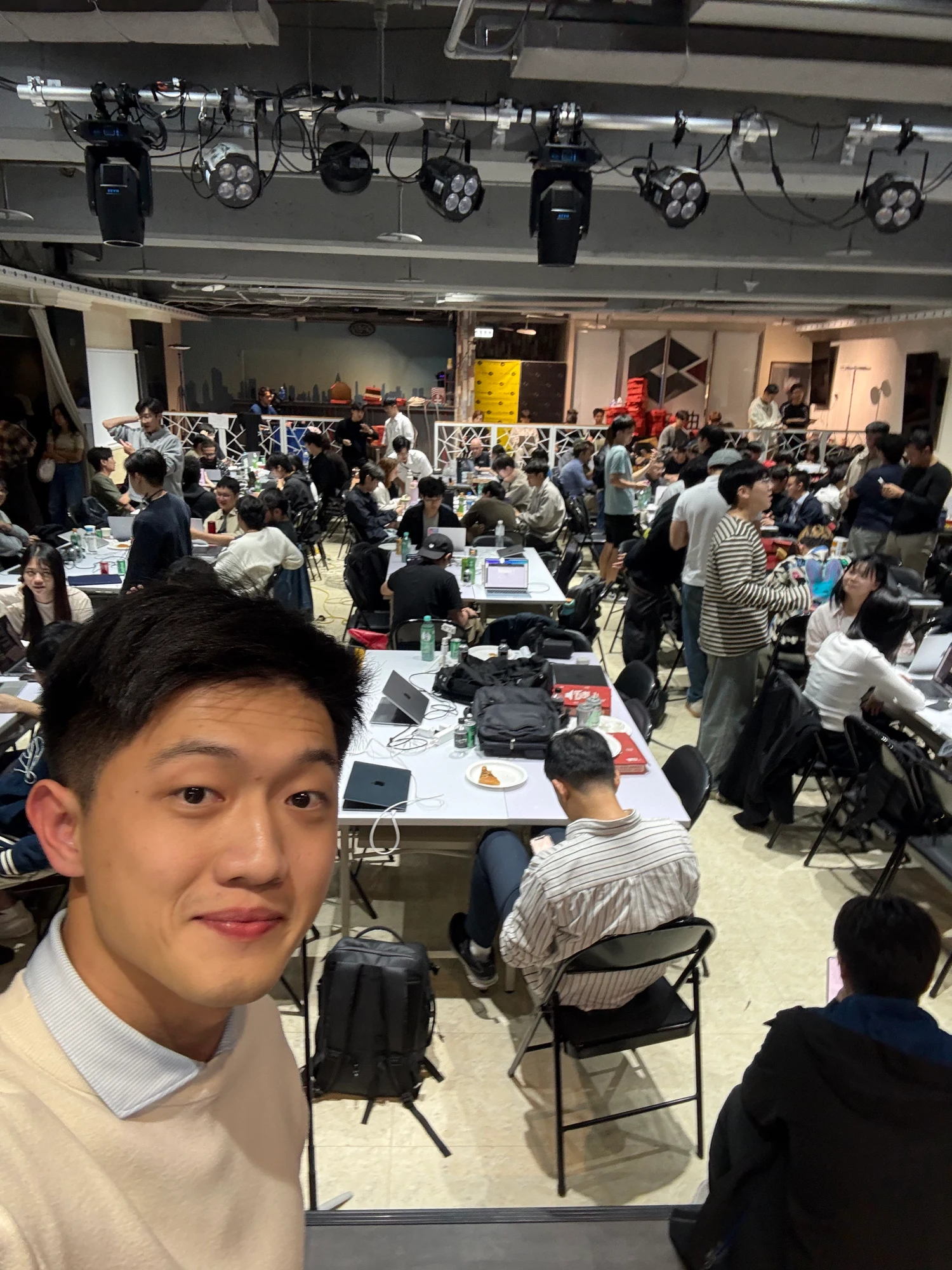
Around the venue, other people were pushing their projects forward too. Some had clear directions; others were still figuring things out. Our backgrounds differed, but when people talked about their work, you could feel their commitment.
One team even managed to sell their software during the event. That was pretty cool to see. I don't know how the transaction developed afterward, but at least that evening, a project had entered a real customer interaction.
Keep Working With Uncertainty
It changed how I saw my nerves before entering. I had wanted to know whether I understood enough and could build something before deciding to participate. Some answers, though, only appear once you begin.
Of course, starting first does not suit every situation. Real navigation and space missions require expertise, preparation, and risk management. I could begin with uncertainty here because the scope stayed inside a computer: I could stop, revise, and preserve mistakes for examination.
Running a company still requires sales, operations, and repeatedly fixing problems. Those activities deliver what we promise customers, and I haven't come to value them less. Alongside consistent execution, though, we can reserve a bounded period of exploration for a problem we do not yet understand.
Thank you to c0mpiled, Transpose Platform, and YC Startup School, and to James Tan, Jacob Yeum, and everyone who made the event possible.
I didn't win a prize, and I didn't become an aerospace engineer that evening. But walking out, I understood more about what this idea could and could not do than the person hesitating outside had.
Don't wait until you're fearless to start.
If I had left that day, nobody would have known. But I would never have known how far that idea I'd been turning over could go.
See the Actual Project
Watch the YouTube Demo / Open the Interactive Fetscape Demo / View the Public GitHub Repository