

TAG STORY · JOURNAL
After Repeated Failures, How Do You Win the Next Time?
From the winner effect and mouse experiments to the startup experience: rebuilding advantages that can accumulate.
TAG Story ·

In September 2014, Nathan Barry's email marketing software, ConvertKit, had fallen to US$1,337 in monthly recurring revenue. He had built a profitable business selling design books and courses, but this product had been stalled for more than a year.
His more experienced friend Hiten Shah had already told him: commit fully or shut it down. In October, Barry finally chose the former. He invested US$50,000, narrowed his audience, and sold directly, beginning to change the company's trajectory. He describes the turning point in his public account of building the business.
The same person had succeeded before and then struggled for a long time. What finally made the next attempt produce a different result?
01 | The Winner Effect: What Did the Mouse Experiment Actually Find?
Can winning once increase the likelihood of winning again? Animal behavior researchers call this the winner effect. A mouse experiment gave that question a specific neuroscientific lead.
In 2017, Hailan Hu's team published a study in Science. Male mice of similar weight that shared a cage entered a narrow tube from opposite ends. They met in the middle and could not pass each other. The mouse that backed out first lost. Repeated pairings revealed a relatively stable competitive hierarchy.
Using optogenetics, the researchers made specific neurons responsive to light, then stimulated the dorsomedial prefrontal cortex (dmPFC) through implanted optical fibers. Mice that had previously yielded more often began pushing forward, resisting, and even defeating opponents that had beaten them.
The particularly interesting part came after the stimulation stopped.
Winning during stimulation did not necessarily leave a lasting advantage. The team compared mice with different numbers of wins. Some returned to their old rank; others retained a higher competitive position after light stimulation ended.
Figure 4A of the original paper groups mice with two to five stimulated wins and those with six to 20. The group with more wins retained its elevated rank during follow-up. The paper's main text describes mice with more than six wins as all retaining the new rank, while most with fewer than five returned to their prior rank.
The two groups in that figure contained 13 and 11 mice, with follow-up showing changes over the days after stimulation. Winning with help at the time and sustaining an advantage after accumulated wins are two distinct things worth observing.
The authors wrote: 「repeated stimulated winning led to sustained dominance without further photostimulation」—meaning that repeated wins under stimulation produced a competitive advantage that persisted without further stimulation.
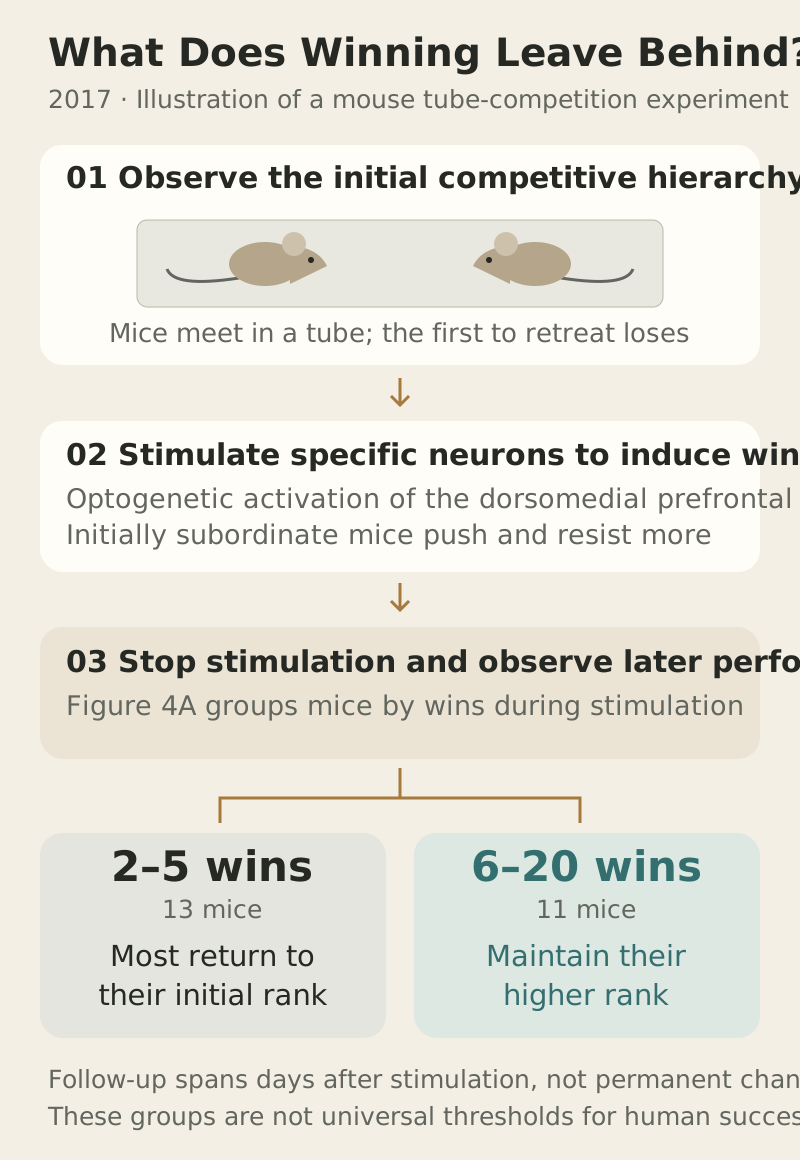
This diagram was redrawn for the article. The groups follow Figure 4A's comparison and are not a threshold for the number of human successes required.
Through neural circuit manipulations, the study also identified a role for the strength of thalamic-to-prefrontal synapses in sustaining the effect. A separate warm-corner competition test showed that the competitive advantage could transfer.The research institution's explanation provides the context for both tests.
What was measured was competitive behavior and rank in mice. Describing them as more confident is intuitive, but confidence was not a psychological state directly measured by the experiment. Nor does this establish that a few consecutive human wins can rewire the brain and guarantee continued success.
02 | How Can One Success Improve the Conditions for the Next?
For people, Bandura's theory of self-efficacy provides another perspective. Beliefs about our ability to perform a specific task affect our effort and persistence; completing the task ourselves is an important source of those beliefs.
Preparing a quote, closing a deal, and completing delivery independently leave concrete experience. At the next meeting, you know which questions to ask first, which promises you can keep, and whether a rejection calls for changing the offer or the target audience.
That confidence has a scope. Being good at design does not mean you understand sales. Delivering one order does not mean you can manage a team of ten. A result offers useful evidence only when it relates to the next task you need to solve.
Success also changes how others respond.A 2014 randomized experiment in PNAS selected 200 unfunded Kickstarter projects with goals of no more than US$1,000, then randomly gave 100 of them initial funding. The proportion that subsequently received contributions from others increased from 39% in the control group to 70% in the funded group.
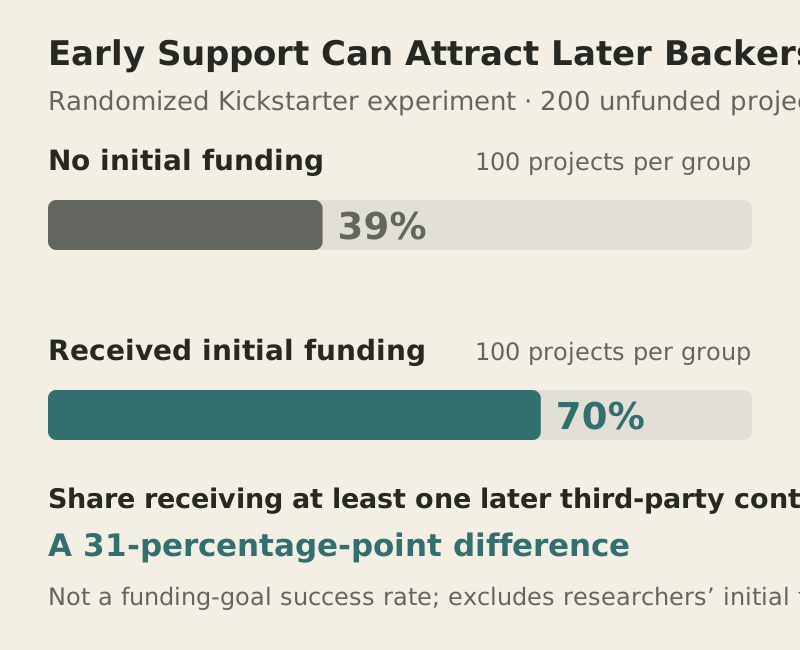
The difference is 31 percentage points. The measure is whether someone else contributed later, rather than the final fundraising success rate.
This reveals two different feedback paths: one through personal experience, the other through growing outside trust and support. A business deal may improve both. Conversely, successful people's access to more opportunities cannot be attributed entirely to greater ability.
03 | After Repeated Failures, What Can You Keep?
Repeated attempts alone do not necessarily build anything cumulative.
Yian Yin and colleagues' 2019 Nature study analyzed sequences of failure in areas including research grants and startups. It developed and tested a model in which retaining effective parts of previous attempts influences whether later efforts improve or remain stagnant. It did not calculate how many failures any person needs before succeeding.
If every product that fails to sell leads you to change the industry, audience, and method altogether, the next attempt may begin from scratch. Keeping validated needs, reusable technology, and customers willing to respond can create a different starting point. Failure can also drain cash or damage relationships, so taking stock cannot stop at what you learned.
I think an environment full of highly capable people can lead us to underestimate ourselves—or mistake exposure for competence. Experience, the ability to complete work independently, and value customers will pay for need to be examined separately.
For founders and successors, a practical approach is to ask both whether a result has outside validation and whether the method can be repeated. The following matrix is a practical synthesis for this article.
Results and methods | Not yet repeatable | Repeatable |
|---|---|---|
Externally validated | Unpack this sale A customer paid. Identify which conditions produced the result. | Increase investment gradually After repeated sales and consistent delivery, test the costs of expansion. |
Not yet externally validated | Make the next test smaller Confirm demand first; reduce the time and capital committed to one attempt. | Check the direction A well-practiced process still needs evidence that someone wants it. |
External validation in the matrix may mean customer payment, repeat purchases, or verified operating improvements. Define the success criteria before acting.
An acquaintance's first order is a real opportunity. Next, find out why they bought, whether they will renew after delivery, and whether customers without that personal connection would buy. This helps distinguish scalable results from those still dependent on special conditions.
04 | In Entrepreneurship and Succession, Which Win Should You Pursue Next?
Barry's changes address exactly that question. He gradually focused on professional bloggers, contacted prospects directly, and offered free migration, taking care of the most troublesome part of switching tools.In his annual review, he identified those decisions as key to growth.
By June 2015, monthly recurring revenue reached US$10,000; by mid-October, it exceeded US$30,000. The first sale, subsequent delivery, and referrals began adding up to an ongoing business.
These actions created a chance for sales conversations, delivery, and referrals to connect. Yet even after investing US$50,000, the company faced expenses above revenue and pressure to reduce staff. That path required resources and carried a risk of failure.
The next effort should target what is actually limiting progress.If you have technology but no customers, pursue a clear commitment to pay. If you have sales but no gross profit, test delivery costs. If there is not enough cash to sustain a test, restoring cash flow can preserve options.
Family business successors face a different situation. You may already command resources but lack an independent contribution the team recognizes. Instead of carrying the whole company immediately, choose a project with authority, a budget, and a deadline—for example, reducing delivery-time variability in a product line. Then check with the team whether your decisions produced the improvement and whether it can last.
The project can be small, but the validation needs to be complete: the objective, actions, outcome, and what can be reused. Success accumulated in that way can inform the next judgment.
Building an enduring business means gradually turning each result into capabilities, relationships, cash, or organizational practices. Before the next win arrives, the most useful question may be:When this attempt ends, what will I have kept that makes the next attempt better positioned?