

TAG STORY · JOURNAL
How Do You Learn to Be a CEO?
From starting a business at 21 to thinking about family business succession
TAG Story ·

By Tim Chen
You cannot learn to run a company from books alone.
The first time I truly took responsibility for a company's operations happened almost by accident.
In 2021, I was 21. Two more experienced businesspeople invited me to start something with them. There was no elaborate business plan or sweeping vision. They simply asked, casually, whether I wanted to give it a try.
It was a technology project. I did not have an engineering background and knew little about the field, but I was enthusiastic and wanted to do it well.
Once the team came together, the money arrived, and the project got underway, I discovered that the reality was different from what I had imagined.
I was the CEO. I had to answer for operating results and for money other people had entrusted to us. But I had never been a CEO. I had no idea how to run a company.
I started to panic.
I Managed Three People with Methods Designed for 300
To fill that gap, I bought management books and studied organizational structures, project management, and corporate governance.
If a book offered a method, I tried it. I drew up roadmaps, scheduled projects, and designed process after process. Looking back, I was trying to manage our three-person team as though it were a company of 300.
Most of it never proved useful.
Meanwhile, more immediate questions were waiting. How should I assess the risks to our funds? When the market changed, when should we adjust? Even with incomplete information, decisions had to be made. Their consequences did not become smaller because this was my first time as CEO.
The books were not useless. I lacked the experience to judge which methods our team actually needed—and which problems did not deserve so much effort.
I also began to understand that the same amount of money can represent very different risks and pressures to people with different experience and capital.
What I lacked most was a set of criteria to guide my decisions.
Admitting You Do Not Know Yet Is Part of Running a Business
A few months in, I finally told my two partners:
“I am starting to think I may not be the right person to be this company's CEO.”
Compared with them, what I had was mostly enthusiasm and a strong desire to get things right.
They did not blame me. They said something I still remember:
“Nobody is born knowing how to be a CEO. You learn it over time.”
I understood what they meant. But while I was still building the skills, the market kept changing. Eventually, we decided to end the project.
That experience made one distinction clear for the first time: participating in a startup project and being responsible for a company's operating results are different things.
Before then, I had worked on several startup projects alongside experienced businesspeople. Those experiences helped. But when the final decision became mine, understanding something did not necessarily mean I could do it.
After that, I began deliberately building the skills running a business required.
I learned to assemble teams and help people from different backgrounds work in the same direction. I learned to understand products and look at decisions from the perspective of the whole company. Finance, equity, fundraising, cold outreach, pitching, sales, marketing—even programming—I began learning them myself.
I wanted the ability to build a company and keep it running.
Five years later, I am still building a business and still learning. The most tangible change is that I am gradually becoming able to develop products, handle finances, plan marketing, find customers, and sell what I make.
That does not mean I have figured out how to be a CEO. I still make mistakes, and there is plenty I do not do well. But I am beginning to understand what my two partners meant.
A CEO develops through repeatedly taking on real responsibility.
Before Taking Over, Can the Next Generation Practice Answering for Results?
This has also made me think about succession in family businesses.
How should the next generation develop the ability to run the family company?
Business school has value: financial analysis, organizational management, and strategy matter. Watching parents run a business also builds understanding. Yet knowing how your parents do something and being able to exercise your own judgment remain some distance apart.
Judgment often begins to develop when you first have to make a decision yourself and face its outcome.
Your first budget, first team, first customer negotiation, first strategy that simply does not work. Each gradually changes how you see a business.
Preparing a successor does not mean gambling the company's survival.
Start with a clearly scoped project, an independently managed budget, and measurable business goals. Let the person take genuine responsibility within risks the company can afford.
For example, assign a new product or customer acquisition project to the next generation. Agree beforehand: What can they decide? What must they report? At what budget threshold should they stop and review? Which results will guide the next discussion?
If every decision ultimately waits for parental approval, the successor may mostly learn how to obtain permission. Practicing management requires room to choose within agreed boundaries, together with responsibility for explaining the results.
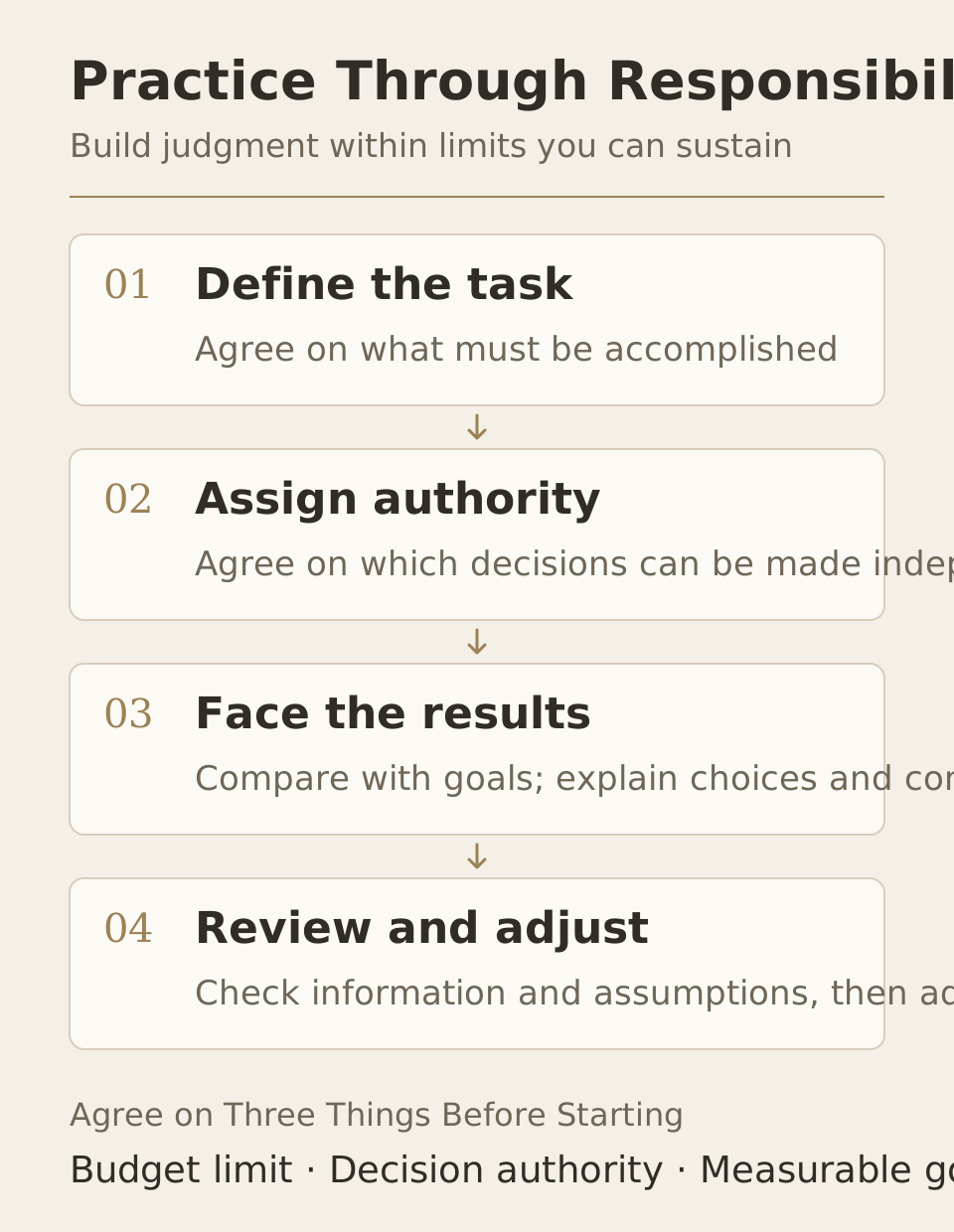
Diagram: connect the task, authority, and outcome within an affordable scope of risk. Based on the perspective developed in this article.
Experience Builds Judgment When You Review It
Having a difficult experience does not guarantee growth.
Without reviewing what happened and understanding the problem, you may make the same decisions next time. A long record of experience can still be a record of repeating the same mistakes.
Review more than the final profit or loss. Consider what information was available, which constraints you overlooked, and which changes should have prompted a different decision.
My first business did not leave me with a success formula I could apply everywhere. It showed me where my abilities fell short. It also taught me to begin asking which methods fit the company in front of me, when to continue, and when to stop.
Experience becomes valuable when it helps us make a better judgment the next time a similar problem arises.
Books can help us understand management principles. Some principles reveal their weight only when we become responsible for the results.
If we hope the next generation will one day carry a company, perhaps we can begin with one task the business can afford—and that they must take seriously.