

TAG STORY · JOURNAL
When a Client Loses Power, Do You Still Stand by the Relationship?
The origins of the Medici story
TAG Story ·

In 1397, Giovanni di Bicci de' Medici, head of a family just beginning its rise, moved the center of his banking business from Rome to Florence.
Giovanni had started as an apprentice at a relative's bank. He went on to run its Roman business, then invested his own money to become a partner, taking on greater and more direct responsibility for the firm's profits and losses.
The problem the Medici Bank addressed was cross-border trade.

A Florentine merchant buying wool from a distant supplier had two choices:
➊ Travel with a chest of gold coins, worrying about theft along the way and dealing with the headache of exchanging currencies.
➋ Work through a bank, arranging for a partner in another city to pay in local currency on an agreed date.
But this was a world without phones, cars, or airplanes. How could a buyer and seller in different cities get money safely into each other's hands?
The Medici made effective use of bills of exchange to manage trust across cities, currencies, and time.
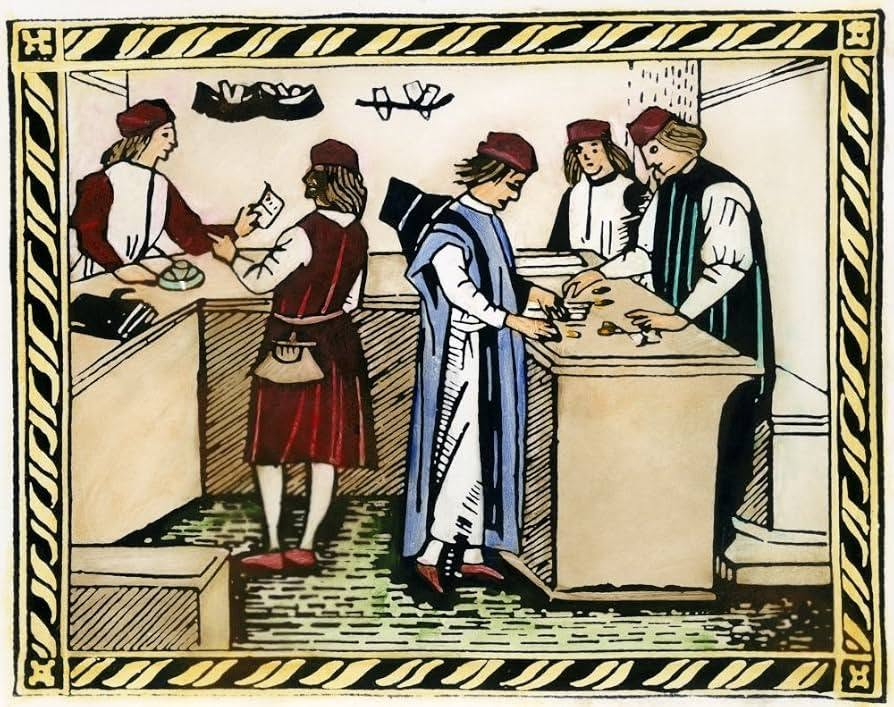
The papal court—what we now call the Vatican—was a major client. Its Roman business contributed more than half of the Medici Bank's profits between 1397 and 1420. One of Giovanni's longstanding contacts was a man named Baldassarre Cossa.
In 1410, Cossa assumed the papacy as John XXIII. The Western Schism had produced rival popes, and Cossa was drawn into that conflict, becoming known as an antipope. After his accession, his financial ties with the Medici Bank deepened.
Five years later, his fortunes reversed.
In 1415, Cossa was deposed and imprisoned. A client who had once brought important business had lost his power and prestige.
The Medici Bank did not cut its business ties with him. Through the bank's agents, Giovanni helped arrange this former pope's release and paid an enormous sum to secure his freedom. In 1419, Cossa finally arrived in Florence.
He died there that same year. In his will, Cossa left money toward his wish to be buried in Florence's Baptistery of San Giovanni.
The Medici may not have extended unlimited support to every client. Still, this relationship raises a question worth sitting with: you often see the quality of a relationship only after the other person's circumstances change.
Serving a client who has a budget, resources, and power is easy to understand. But when that client suddenly loses in the market, loses influence, or becomes someone everyone wants to avoid, what do you do with the relationship?
One of the hardest things about relationships is discovering that the seemingly endless goodwill around you depended on your success. The moment you stumble or make a mistake, people change sides to protect themselves, and the warmth disappears.
For anyone building a business for the long term, closing the deal is part of the relationship. Taking care of what follows matters just as much.
That long-term approach is part of why the Medici remain a legend we still talk about, more than 500 years after their bank disappeared.