TAG STORY · JOURNAL
The Shares Have Passed Down. Has Control Survived?
Family Office Series · Vol. 02
TAG Story ·

After passing shares to the next generation, can a family still decide the company's future together?
This is an easily overlooked risk in succession.
While the founder is still involved, everyone can turn to the same person to coordinate. After several generations, the shareholder base expands. Family members' lives, careers, and financial needs diverge. Even if everyone values the business, they may not want to own it in the same way.
Some need cash. Others want dependable dividends. Still others can wait for long-term growth. Each may make a reasonable decision individually, yet together those choices can change the family's ownership and influence.
Hermès' H51 offers a real example worth studying.
It shows us that managing risk sometimes means pooling ownership and establishing shared rules, so separate personal choices do not gradually undermine the family's long-term goals.
01 | What Risk Was Hermès Facing?
Hermès' 2011 annual report shows that LVMH's share of Hermès' capital rose from about 20.21% at the end of 2010 to about 22.28% at the end of 2011.
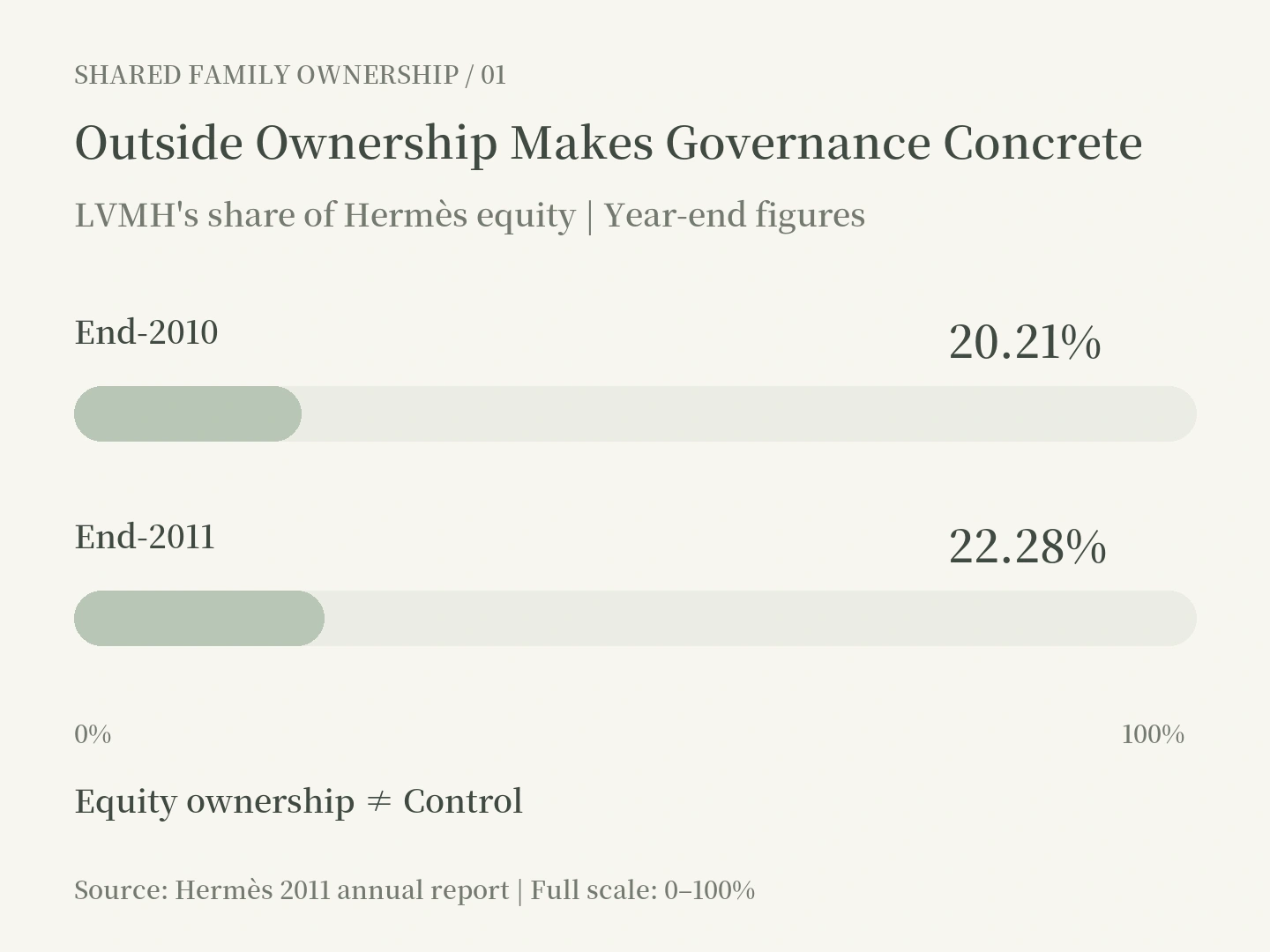
That did not mean LVMH had gained control. But an outside shareholder's growing stake made the preservation of family influence a concrete governance issue.
A family hoping to remain independent over the long term must look beyond the sum of its members' shares. Can those shares form a stable collective holding? What happens when an individual wants to sell?
Dispersed ownership creates a risk that separate personal choices will affect a shared objective.
In 2011, the Hermès family brought approximately 50.2% of the company's capital into the H51 holding company. According to the formal announcement that year, H51 also acquired a right of first refusal over certain shares still held directly by family members.
That turned a wish to keep owning the business together into mechanisms for ownership and share transfers.
02 | H51: Pooling Shares and Managing the Risk of Their Leaving the Family
Start with two elements.
First, bring dispersed shares into a shared holding structure.
Participating family members held the corresponding Hermès shares indirectly through H51. A substantial block now had one holding entity, and some governance questions could be addressed within a common corporate structure.
Individual asset decisions now had to connect with the rules of collective ownership.
Second, establish a right of first refusal over certain directly held shares.
When those shares were offered for transfer, H51 could exercise that right under the agreement. This improved the shared structure's opportunity to acquire them and made the selling process more predictable.
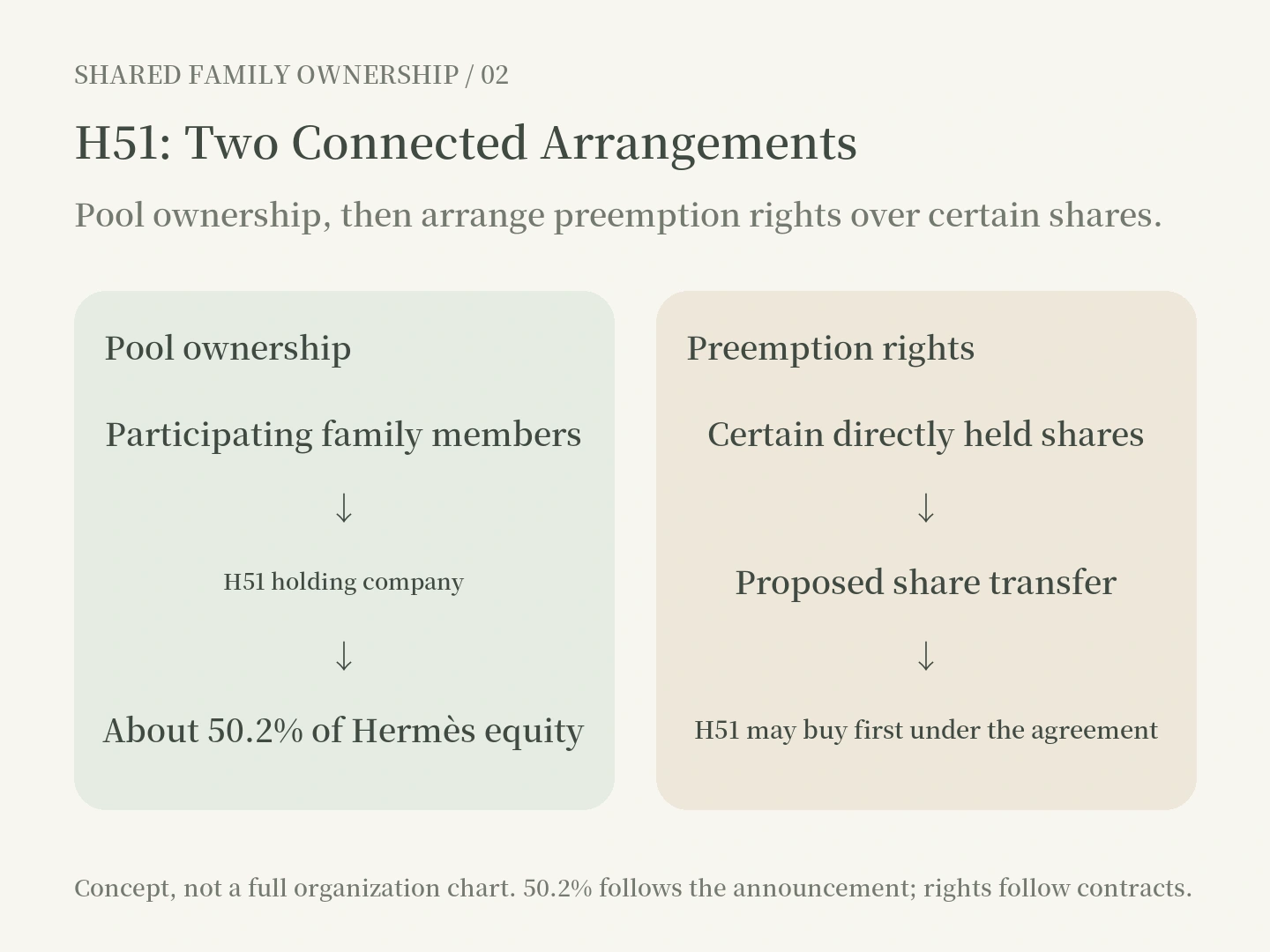
From a risk management perspective, these two arrangements can be understood as reducing the effect that individual changes in ownership and transfers to outsiders could have on collective control.
H51 itself, however, is a family holding company. It should not simply be called a family office.
The lesson remains useful: identify the risk, then coordinate the ownership arrangements, documents, and procedures needed to address it.
03 | The Tradeoffs After Concentration
Maintaining control and diversifying family wealth are separate objectives that need separate attention.
A shared structure may stabilize ownership. But if the family's wealth remains heavily concentrated in one company, the company's performance still affects the value of those assets.
Collective ownership also creates new questions.
If someone needs cash, who can buy their stake? How is the price determined? Does the shared structure have sufficient funds? When members disagree, what process produces a decision?
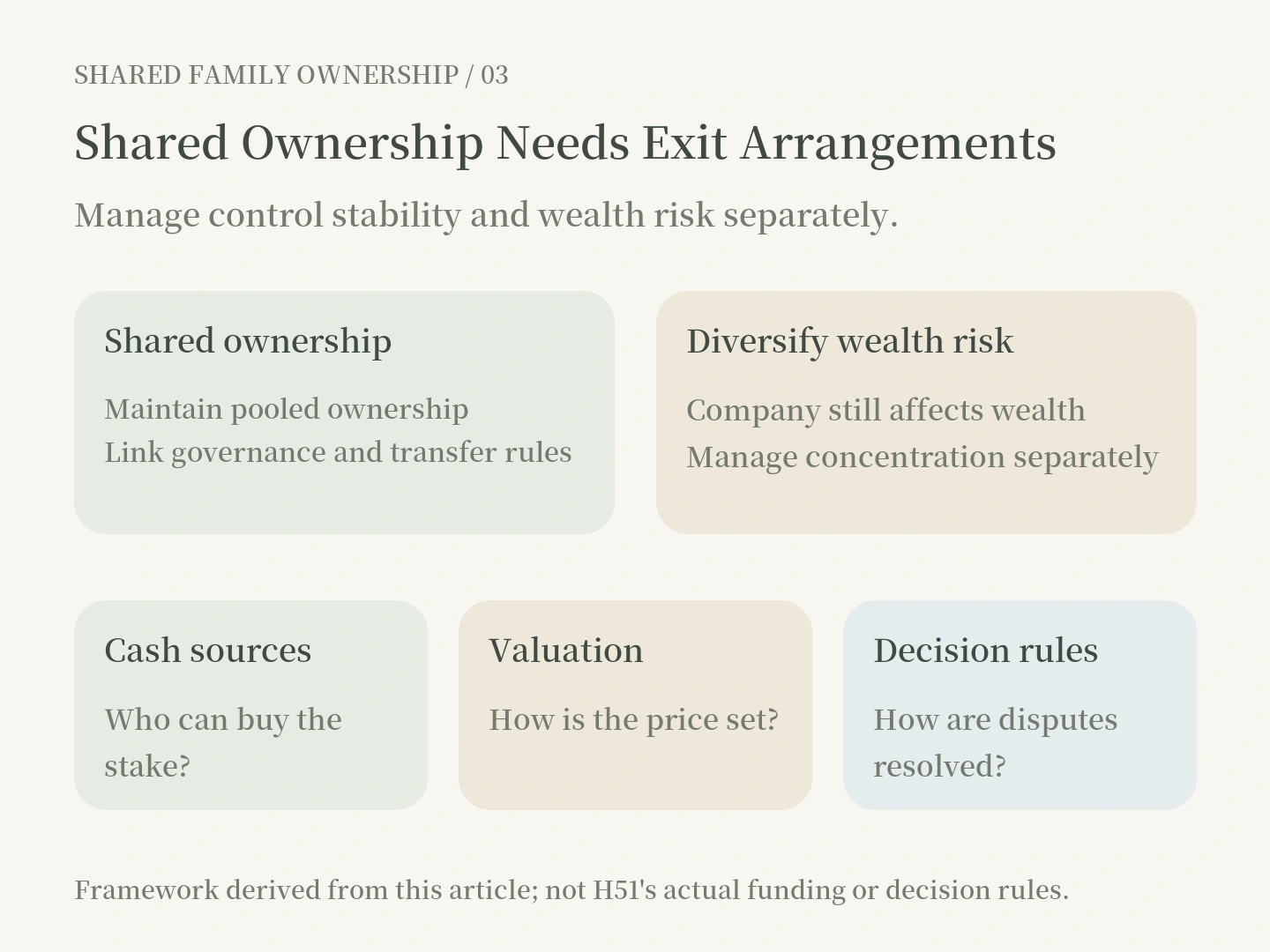
When studying H51, the supporting arrangements behind the holding structure deserve close attention.
Hermès' 2011 annual report also discloses a price calculation method for the relevant rights of first refusal, with experts using several criteria to value shares in specified circumstances.
For a structure like this to last, it must first answer what happens when someone wants to sell. Hoping everyone will stay, without guardrails against human self-interest, is not enough.
Families that want to remain joint owners need to help members understand what staying and leaving each entail.
04 | What Does This Mean for First-Generation Founders?
One of the most valuable interpersonal skills a founder can practice is the ability to negotiate a shared objective。
Telling the next generation “the company cannot be sold” expresses your position. The next step is explaining why you want it to continue, under what conditions a sale could be considered, and whether you hope your children will take on management responsibilities or shareholder responsibilities.
Different people may be willing to take on different roles. If founders want their children to accept these responsibilities willingly, they need to listen to individual needs and understand differences in personality.
A simple, relaxed family meeting can be a starting point: talk with each potential successor about the role they would like to play in the family business.
A Family Office's Value: Keeping Risk Under Active Management, with Information and Rules
What makes H51 especially instructive is the way it translated the family's desire for shared ownership into an executable strategy.
According to PwC's description of family office services, governance, decision rights, accounting and reporting, risk, and succession all need to connect. A family office can coordinate this work over time, but the respective responsibilities of the holding company, lawyers, and family members require further discussion.
Shares can be distributed among different people. If a family wants to remain joint owners for the long term, it needs to arrange in advance how decisions will be made, how information will be obtained, and how differing needs will be handled.
References
Hermès 2011 Annual Report: capital and shareholder information; rights of first refusal and valuation arrangements, printed pages 81–88.
Hermès International: 2011 SALES, formal announcement dated February 9, 2012.
PwC: Family office services—coordination of governance, decisions, risk, and succession.