
TAG STORY · JOURNAL
What Is a Family Office?
Family Office Essentials · Vol. 01 | Definition, history, and core functions
TAG Story ·

01 | What Is a Family Office?
A family office is a professional organization that coordinates wealth management, family affairs, and long-term succession for a wealthy family. [3]
Its scope may include investments, cash flow, legal and tax coordination, family governance, education for the next generation, and philanthropy. Its specific responsibilities and size depend on the family's needs.
Some families build a dedicated team. Others use external institutions, or a small internal team that coordinates investment managers, lawyers, accountants, and banks. The central role is to align different professional services around shared family objectives.
Private banks also provide investments, trusts, financing, and wealth planning, and may work with family offices. The services overlap. A family office places particular emphasis on coordinating the family's overall needs and its different service providers. [3]
02 | Rockefeller and the Development of the Modern Family Office
One important early example of the modern family office comes from Standard Oil founder John D. Rockefeller。
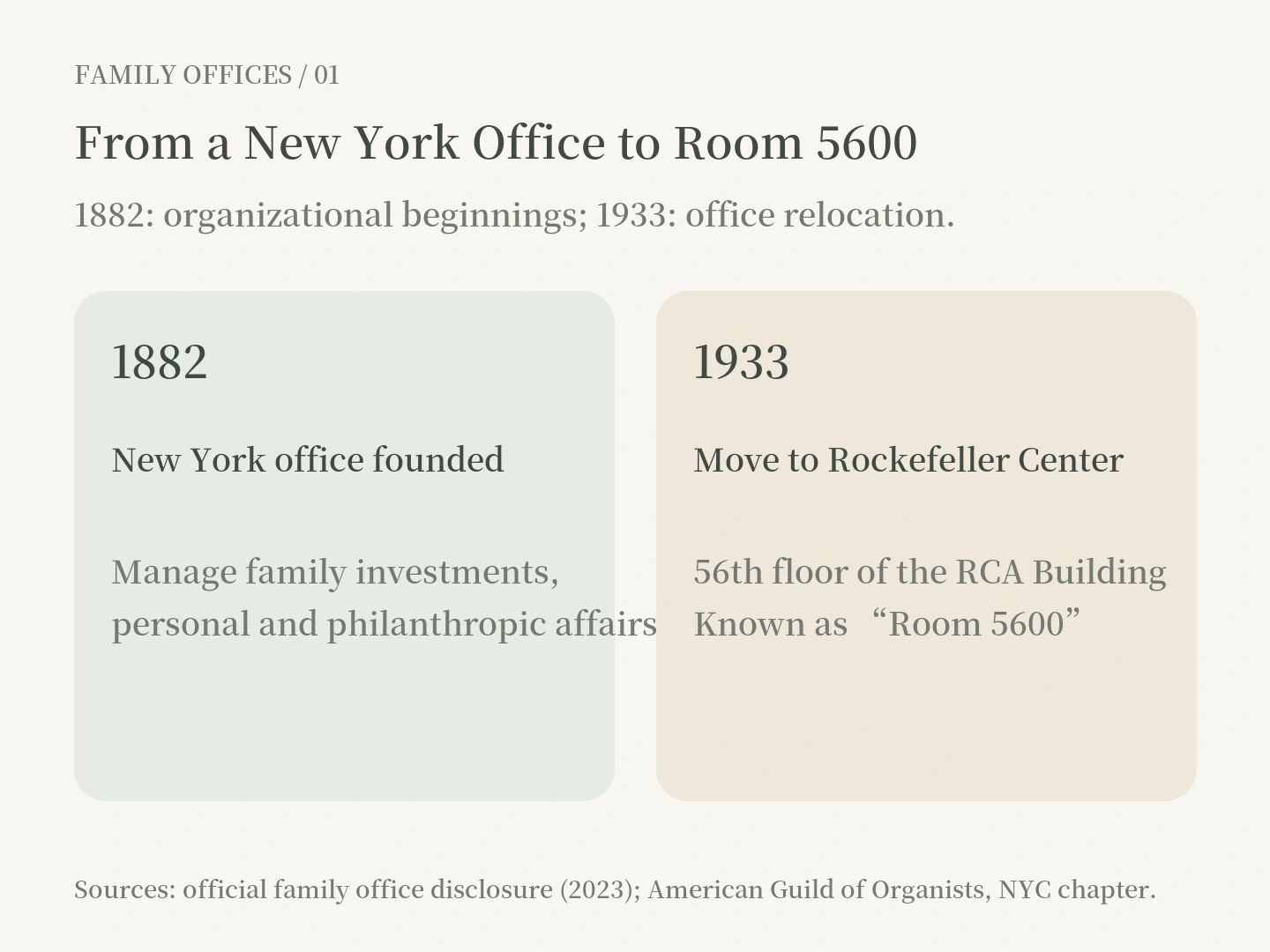
According to Rockefeller & Co.'s official disclosures, its predecessor dates to 1882, when Rockefeller established an office in New York, United States, to manage family investment, personal, and philanthropic affairs. [1]
The significance lay in using a dedicated organization to coordinate family affairs beyond the operating business, bringing investments, personal matters, and philanthropy into one management structure. Rockefeller is consequently regarded as an important pioneer of the modern professional family office. That does not mean the history of family wealth management began with him.
In 1933, the office moved from Standard Oil's headquarters to the RCA Building at Rockefeller Center, now 30 Rockefeller Plaza. The office on the 56th floor became known as Room 5600. [2]
03 | What Does a Family Office Manage?
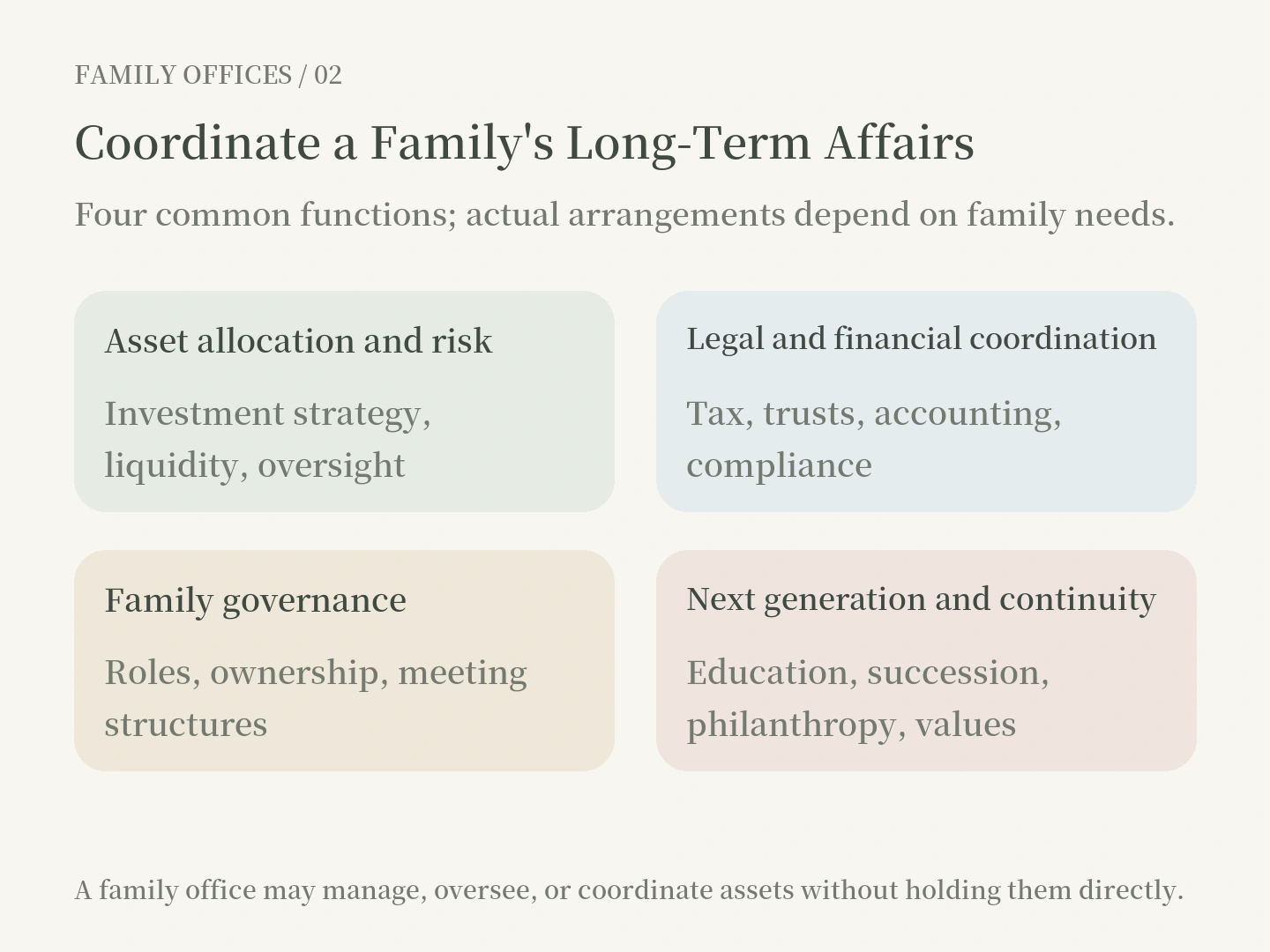
Services typically fall into four areas, with some work performed internally and some entrusted to outside specialists. [4]
• Asset allocation and risk management: Consolidate investment and asset reporting; monitor allocation, cash flow, liquidity, and overall risk.
• Legal and financial coordination: Coordinate lawyers, accountants, tax specialists, and trust experts across entities, assets, and borders.
• Family governance: Clarify ownership, management, and decision rights; establish family meetings, benefit allocation, and dispute resolution mechanisms.
• The next generation and long-term succession: Plan education, succession preparation, philanthropic participation, and continuity of family values.
These functions connect. An investment's funding requirements, for example, may also affect household spending, philanthropic commitments, and succession arrangements. The family office coordinates the relationships among those decisions.
04 | How Large Is the Market?
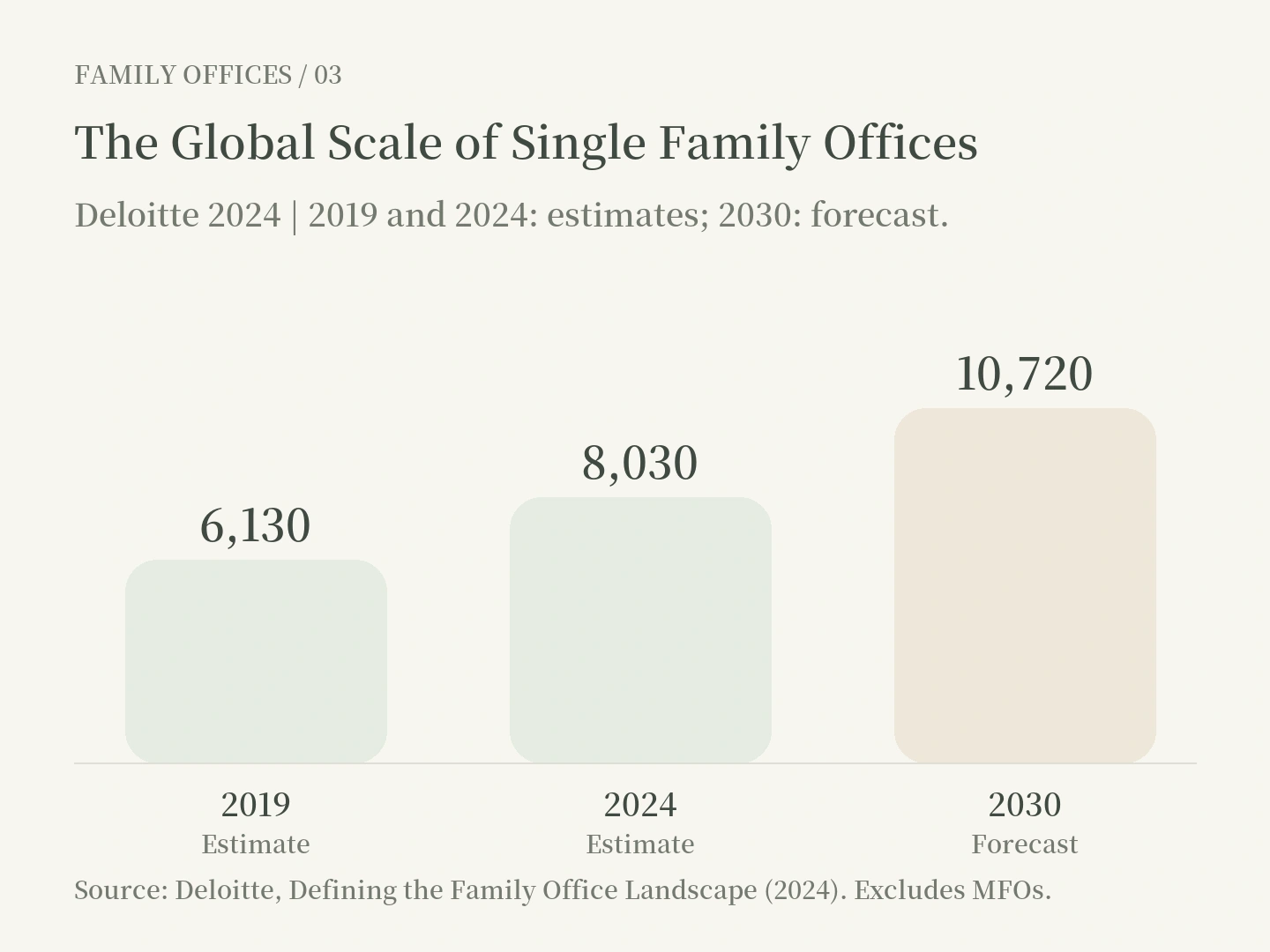
Deloitte's Defining the Family Office Landscape 2024 estimates approximately 8,030 single family offices (SFOs) worldwide in 2024, up from an estimated 6,130 in 2019. The study projects that the number could reach 10,720 by 2030. [5]
US$3.1T | Estimated global SFO assets under management in 2024: approximately US$3.1 trillion
US$5.5T | Estimated total wealth of those families: approximately US$5.5 trillion
A more recent survey is UBS' May 28, 2026 Global Family Office Report 2026. It covers more than 30 markets and 307 surveyed family offices. The participating families had average net worth of approximately US$2.7 billion, while the offices each managed an average of approximately US$1.3 billion in assets. [6]
These are averages within a UBS client sample. They are neither the average size of all family offices worldwide nor a threshold for establishing one.
In Asia, the Monetary Authority of Singapore (MAS) stated on August 5, 2026, that at the end of 2025, more than 2,000 SFOs benefited from designated tax incentives. This counts the offices receiving those incentives, rather than every family office in Singapore. [7]
Source | What it measures | Scope |
|---|---|---|
Deloitte 2024 | Estimated global SFO numbers and assets | 2024 global estimates |
Deloitte 2030 | Projected future scale | 2030 projections |
UBS 2026 | Sample statistics for 307 surveyed offices | UBS client sample |
MAS 2026 announcement | Number of SFOs receiving designated incentives at the end of 2025 | Designated tax incentive scope |
05 | How Does AUM Differ from Assets in Custody?
AUM stands for assets under management.It describes assets being managed. It is neither money owned by the family office nor its revenue.
Management and custody are different functions. A family office may set strategy, oversee investments, and consolidate reports while assets sit with banks, brokerages, or other custodians. Rockefeller's disclosures explicitly describe third-party custody arrangements. [1]
Term | Definition |
|---|---|
Family net worth | The value of all family assets after liabilities. |
AUM | The value of managed assets, calculated according to the chosen management scope and methodology. |
Assets in custody | The value of assets held by a custodian. |
Deloitte's US$3.1 trillion figure represents assets under management, rather than assets held directly in custody by family offices.
06 | Whom Do Family Offices Serve?
The need often arises as wealth grows, asset types change, or family structures become more complex. Examples include:
• First-generation founders: Wealth extends from operating company equity into investments, real estate, and other assets, creating a need to integrate personal and family finances.
• Founders after a business sale or IPO: A sale, IPO, or other liquidity event produces substantial liquid funds, requiring a fresh approach to allocation, risk, and future spending.
• Second- and third-generation families: More members and increasingly distinct roles as managers, shareholders, and beneficiaries create governance and responsibility needs.
• Families with members and assets in several countries: Different places of residence, asset locations, and legal systems add complexity to cross-border coordination and succession planning.
Whether a family office model is appropriate generally depends on the complexity of assets and family affairs, service needs, and the cost of a dedicated team. [3]
07 | SFO and MFO: A Dedicated Team or Shared Resources
The two most common models are the single family office (SFO) and multi-family office (MFO). [3]
Comparison | SFO | One family | MFO | Several families |
|---|---|---|
Clients | One family | Several families |
Organization | Dedicated team, with outside experts as needed | Shared team, systems, and research resources |
Fees and costs | The family typically bears operating costs | Management, advisory, or project fees under a service agreement |
Main tradeoff | Greater control and customization, with responsibility for managing the team | Shared costs, with service depth and alignment of interests to assess |
An SFO's mandate is generally to serve its family. An MFO may be a professional services business serving outside clients. Similar names can conceal different organizational and economic models.
Service depth, fees, and conflict-of-interest arrangements may differ significantly. The name “family office” alone does not establish a uniform scope of service.
08 | Objectives and Long-Term Succession
From a management perspective, the objectives can be grouped into three areas:
• Integrate wealth management: Build an overall view of assets, risks, and cash flow, and coordinate arrangements across markets, entities, and service providers.
• Establish family governance: Clearly define decision responsibilities, ownership, and benefit allocation, with procedures for cooperation across members and generations.
• Develop the next generation's capabilities: Use education, practical participation, and succession preparation to help the next generation manage assets and carry family responsibilities.
A professional organization still needs agreement among family members. PBS' The Rockefellers records how the third-generation brothers became involved in Room 5600 after World War II. Nelson challenged his father's control of the office and changed its staffing and ways of working. [8]
Modern surveys also suggest that professional investment management and succession preparation have not advanced together. In UBS' 2026 survey, 35% of surveyed offices had a clear family office succession plan, while 27% had a structured process for educating and preparing the next generation. [6]
These percentages measure formal plans and processes. They do not imply that the other families had no education or succession arrangements at all.
The long-term role of a family office is to embed wealth management, governance, and succession in an ongoing organization, reducing dependence on any one member.
References
[1] Rockefeller Global Family Office: Form ADV Part 2A, March 30, 2023, Item 4; advisory and custody arrangements.
[2] American Guild of Organists, NYC Chapter: John D. Rockefeller, Jr. Residence; the office's 1933 relocation.
[3] J.P. Morgan Private Bank|What is the difference between single family and multi-family offices?
[4] PwC: Family office services; functions, governance, and succession.
[5] Deloitte: Defining the Family Office Landscape, 2024; global SFO estimates and 2030 projections.
[6] UBS: Global Family Office Report 2026, May 28, 2026; sample, assets, and succession statistics.
[7] Monetary Authority of Singapore|Written reply on the number of Single Family Offices(2026-08-05)
[8] PBS American Experience: The Rockefellers; Room 5600 and the third generation's involvement.