

TAG STORY · JOURNAL
If a Company Is More Efficient Than Every Competitor, Does It Deserve the Entire Market?
TAG Story ·
Rockefeller's First Advantage Was Efficiency
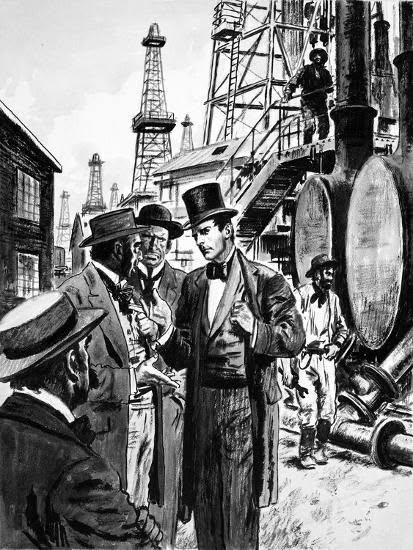
In 1859, the Drake well struck oil in Pennsylvania, setting off a rush. Some people went digging, hoping the next shovelful would uncover black gold. Rockefeller chose a different path: refining.
In 1863, he entered the refining business with his partners and brought in Samuel Andrews, who understood the process.
Andrews contributed refining expertise. Rockefeller contributed the financial instincts he had developed over years.
Rockefeller was no petroleum engineering genius. His gift was breaking a complicated business into detailed accounts, then finding opportunities for improvement in the numbers.
In 1865, disagreements over the business's direction led his partner Clark to put the refining operation up for auction.
Rockefeller won control with a bid of $72,500.
Only then did he truly take charge of his own refining business.
A Barrel of Crude Should Yield More Than One Product
Most refineries at the time focused on one product: kerosene.
Other substances separated from crude were sometimes dumped as waste, burned as fuel, or sold off at very low prices.
Rockefeller began asking a different question:
If we have already paid for the whole barrel, why should only part of it earn money for the company?
Standard Oil found uses for byproducts, turning what had been waste into saleable fuels, lubricants, paints, adhesives, and other products.
That changed its competitive position directly.
Suppose Company A and Company B each spend 100 monetary units on a barrel of crude.
♣ Company A can recover 100 units from kerosene alone.
♠ Company B can sell the byproducts for another 20 units on top of its kerosene revenue.
Company B now has choices:
➤ Lower the price of kerosene.
➤ Absorb higher raw material costs.
➤ Reinvest the extra profit in equipment.
➤ Or expand further.
An apparently modest reduction in waste becomes a new source of competitive firepower. Standard Oil became Company B.
Rockefeller then turned his attention to barrels.
Oil was transported mainly in wooden barrels, and the barrels themselves were expensive.
Standard Oil set up its own cooperage, then invested in large storage tanks, warehouses, and loading equipment, integrating more of the operation vertically.
It did not simply take the savings out as profit. It reinvested them in the next round of improvements.
⏺︎ Better use of raw materials → lower costs
↪︎ Lower costs → better prices
↪︎ Better prices → more orders
↪︎ More orders → greater investment in logistics
↪︎ Lower logistics costs → further cost reductions
A flywheel began to turn.
By 1872, Standard Oil had acquired many Cleveland refiners and established its own cooperage, large storage tanks, warehouses, and paint and adhesive factories.
Without Rockefeller's exceptional operating ability in those early years, Standard Oil could never have reached the scale from which it later controlled the market.
So, back to the opening question: if a company is more efficient than every competitor, does it deserve the entire market?
Rockefeller answered with his life's work: he did take the entire market. He did not win it by using capital to establish a monopoly. He built that position by making every barrel, every ledger, and every operating step waste a little less and create a little more value than his competitors.