

TAG STORY · JOURNAL
When Your Father Is Also Chairman, Who Should the CEO Listen To?
The Trade-offs of Control · Part Two
TAG Story ·
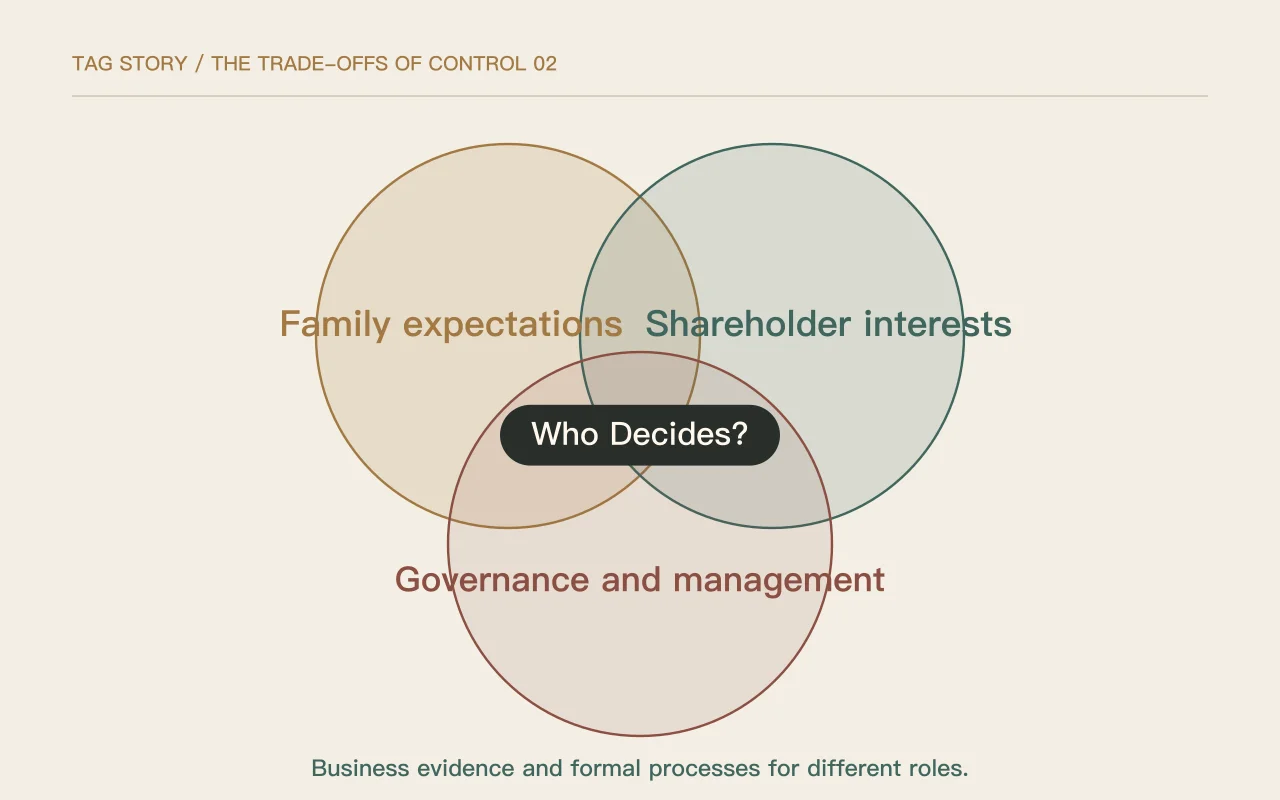
It is nine at night. Only you and your father remain in the company conference room.
On the table sits a freshly prepared annual financial report.
You are the second-generation CEO of a Taiwanese textile business. Your father founded it more than thirty years ago. He has handed daily operations to you but remains chairman.
A traditional textile division has lost money for five consecutive years. Last year's accounting loss reached NT$20 million.
After weeks studying the financials and industry trends, you believe the company should stop investing in this business and redirect resources toward products with greater growth potential.
Your father disagrees.
“You only see how much this division loses. You don't see how many relationships it built for us.”
He points to employees who have served for more than twenty years and suppliers who have worked with the company since its earliest days.
Some of its customers later became important partners for other divisions.
He believes the division can return to profitability when the market recovers.
You see it differently.
If every division must stay open because of what it contributed in the past, how much can the company invest in its future?
You do not want sentiment to overrule business judgment.
But the person across the table is more than your chairman.
He is also the father who led the company through several crises and taught you how to run a business.
If he still opposes you at the final board meeting, what should you do?
(The father, son, and textile company below are hypothetical. The scenario explores governance issues examined in real research.)
1. One Person, Three Different Roles
In 1978, Renato Tagiuri and John Davis at Harvard Business School developed a framework for analyzing family businesses. It later became known as the Three-Circle Model.
The model identifies three overlapping systems within a family business:
family, ownership, and business.
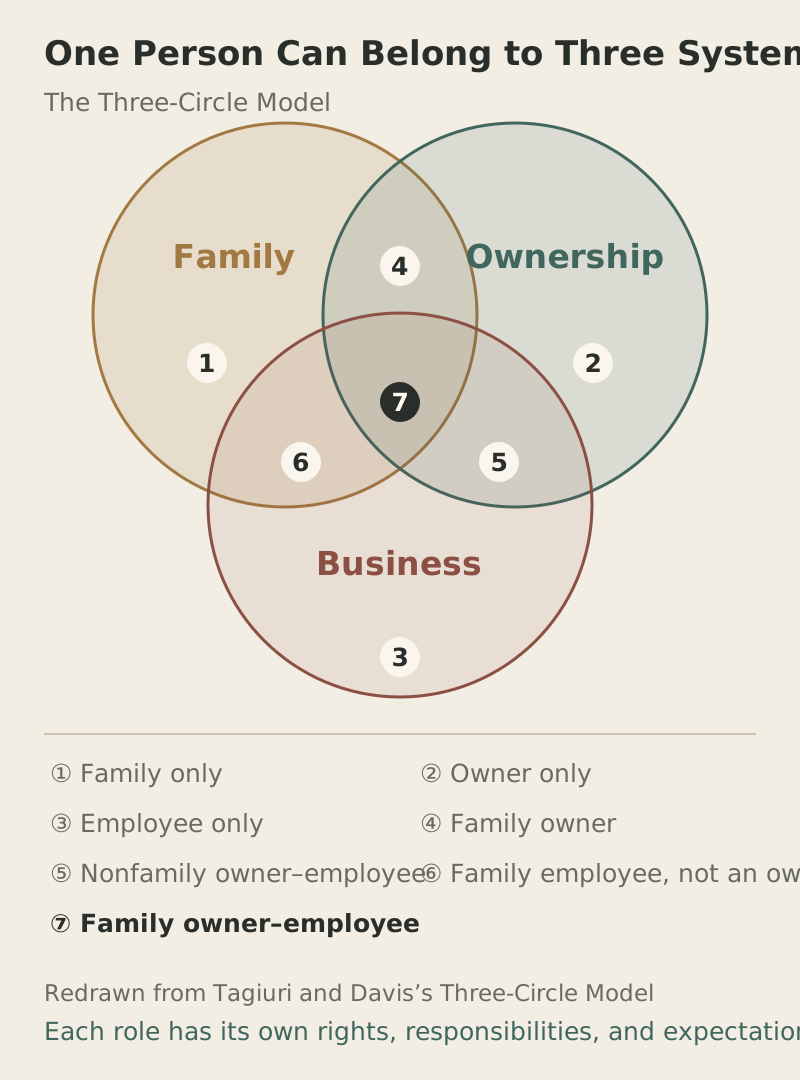
Figure 1 | Redrawn from Tagiuri and Davis's Three-Circle Model. Intersections show overlapping roles, not that one identity has greater decision-making authority.
A person may belong to just one system, to two, or to all three.
Each role carries different rights, responsibilities, and expectations.
Now return to your father.
As a father, he wants you to respect his experience and preserve the emotional ties and relationships the company has built.
As a shareholder, he cares about the company's long-term value and whether the family can continue earning a reasonable return.
As chairman, he must consider strategy, financial risk, and whether this decision serves the company as a whole.
The same applies to you.
You are a son, a shareholder, and the CEO accountable for daily operating results.
When these expectations align, family relationships can be a significant business advantage.
When they conflict, the issue goes beyond whose business judgment is right.
You might respect your father as a son yet become a CEO unable to make independent decisions.
Or you might act decisively as an executive but communicate so poorly that you leave lasting damage to the family.
The real value of the Three-Circle Model is helping us identify which roles and expectations are actually in conflict.
It does not prove that family should give way to business or require the CEO to put performance above every relationship.
It reminds us that the rights and responsibilities of different roles cannot be mixed at will.
If your father opposes a budget as chairman, he should present his reasons through formal governance procedures.
If he questions returns as a shareholder, he is entitled to reasonable information and accountability.
But if he wants a business decision changed simply because he does not want his son to defy him, that family expectation should not automatically become a company instruction.
Likewise, being CEO does not entitle you to assume his judgment is outdated.
First establish who has authority to close the division, rather than letting personal relationships determine the outcome.
Identify the Role, Then Establish the Authority
Role | Legitimate expectations or requests | Where to address them |
|---|---|---|
Father / son | Respect experience; sustain emotional and family ties | Family communication; family expectations do not automatically become company instructions |
Shareholder | Reasonable information, returns on capital, and management accountability | Applicable law, company constitution, and shareholder rights |
Chairman / CEO | Strategy, risk, and operating proposals | Establish formal authority, then follow governance procedures |
Respecting experience does not mean surrendering judgment. Holding a position does not mean having every answer.
2. Reluctance to Challenge Your Father May Be About More Than Filial Duty
Suppose you have established that your proposal has a sound business case.
Yet in the boardroom, you still hesitate.
Your father is the founder, after all.
He grew the company from a small factory and took risks you have never experienced.
Would closing the division mean rejecting thirty years of his work?
A second theory is useful here: successor commitment.
In 2005, Pramodita Sharma and P. Gregory Irving published research in Entrepreneurship Theory and Practice identifying four bases of commitment among family business successors.
Successor Commitment: Staying Can Reflect Different Motives
Basis of commitment | Reason for staying | A phrase that captures it |
|---|---|---|
Affective | Enjoying the business and identifying with its mission | I truly want to stay. |
Normative | Feeling responsible for continuing the family business | I feel I should stay. |
Calculative | Leaving would sacrifice benefits, status, or prior investments | The cost of leaving is too high. |
Imperative | Lacking other viable options | I feel I have no other path. |
These motives can coexist and change across life stages.
The researchers proposed a theoretical model. They did not establish that one form of commitment necessarily produces better operating performance.
Now consider why you hesitate to oppose your father.
With normative commitment, you may see respect for your father and continuity of the business as duties.
With calculative commitment, you may fear losing inheritance arrangements, shareholder support, or even your future as CEO.
With imperative commitment, you may have worked in the family business since graduation and never considered what you could do elsewhere.
All three can look like an inability to speak up.
But the underlying problems are entirely different.
Being willing to inherit a business does not mean being able to run it independently.
Conversely, independent judgment does not require rejecting the previous generation's advice.
A mature successor must distinguish decisions made for the business from those driven by family duty, personal status, or a desire to prove themselves.
To avoid offending your father, you might keep funding a division that no longer has economic value.
To prove you can reform the company, you might close a business that still has long-term value too quickly.
Both decisions can be emotional.
One simply looks conservative, while the other looks decisive.
3. Why Can Capable Managers Still Make Decisions That Hurt the Company?
This brings us to a third theory: agency theory.
In 1976, Michael Jensen and William Meckling published a landmark paper examining why agency costs can arise when owners delegate decision-making to managers.
The simplest case is a shareholder who wants long-term value and a CEO who also cares about compensation, tenure, and reputation.
Their interests do not always align.
For example, a professional CEO knows an R&D investment could create value five years from now but would reduce this year's profit.
If their bonus depends mainly on this year's financial results and they may retire in two years, they might postpone it.
The problem is not a lack of expertise.
It is a conflict between the company's need for long-term investment and the executive's personal short-term interests.
In 2005, Graham, Harvey, and Rajgopal published a survey of 401 financial executives.
About 55% said they might delay starting a new project to meet a quarterly earnings target, even if doing so sacrificed a small amount of firm value.
These were self-reported inclinations, not evidence that 55% of companies actually did so. Still, they show how short-term incentives can influence decisions even when managers understand what might create long-term value.
Does the agency problem disappear when the CEO is a family member?
No.
In Organization Science in 2001, William Schulze and fellow researchers argued that concentrated family ownership and management may reduce some conflicts between outside shareholders and managers, while also creating problems involving self-control, family altruism, and insufficient monitoring.
Return to your father.
He may have valuable industry knowledge. He may also overestimate the division's future because it holds so many personal memories.
You may have the opposite bias.
You want to be the person who changes the company. Closing this division might improve profits, but it also signals to everyone that a new generation is finally in charge.
Could that motive be shaping your judgment too?
Your father may resist reform to protect the past. You may push reform too far to prove the future.
Agency Problems: What Should We Examine Beyond Expertise?
Decision-maker | Incentives that may diverge from the company's interests | Evidence to request |
|---|---|---|
Professional CEO | Bonuses, tenure, and personal reputation | Are current performance targets obscuring the investment's long-term value? |
Father / founder | Memories, established relationships, and past achievements | Do customer networks and technology still have verifiable future value? |
You / successor CEO | Demonstrating reform capability and signaling control | Is closure still better than downsizing, transformation, or a sale? |
Agency theory does not ask us to assume every manager is selfish. It asks us to recognize that even good intentions need institutions that test whether personal and organizational interests align.
4. Do Five Years of Losses Mean It Should Close?
Your father makes a request.
“You say this division loses NT$20 million a year. If we close it, will the company really earn NT$20 million more?”
Your first instinct is to say yes.
But a second look at the financials reveals a more complicated answer.
Suppose its annual management accounts look like this:
Illustrative Annual Divisional Income Statement
Item | Amount (NT$) |
|---|---|
Revenue | +100 million |
Product and direct variable costs | −65 million |
Fixed costs eliminated by closure | −40 million |
Allocated head-office costs | −15 million |
Accounting profit / loss | −20 million |
The critical distinction is between the final two cost categories.
If head-office staff, offices, and other shared costs remain after closure, the NT$15 million does not disappear.
Before head-office allocations, the division actually loses just NT$5 million annually.
If it closes and all avoidable costs can genuinely be eliminated immediately, annual company earnings improve by NT$5 million, not NT$20 million.
But the analysis is not finished.
Further investigation shows that customers first brought in through this division also buy from other divisions.
Suppose losing those relationships would reduce their annual contribution profit by NT$9 million.
Recalculate:
Closing saves NT$5 million but removes NT$9 million of contribution elsewhere.
The company as a whole earns NT$4 million less each year.
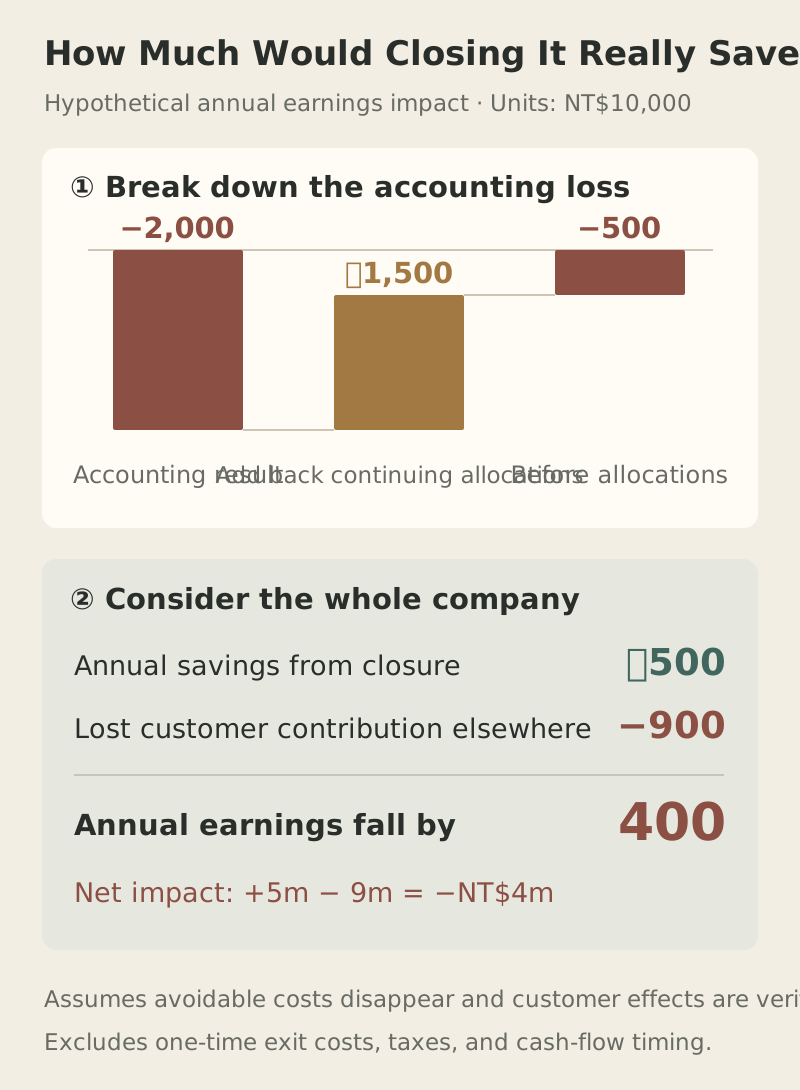
Figure 2 | Recalculate the economic impact of closure across the entire company. This is the original article's hypothetical annual earnings example; a full investment appraisal must separately account for cash flows and exit costs.
Of course, this assumes the costs and customer effects can be substantiated. An actual decision must also consider severance, equipment disposal, contractual penalties, taxes, and cash-flow timing.
Still, the example reveals what your original analysis missed:
A division's accounting loss is not the economic benefit the company would gain by closing it.
That is the core of incremental cash flow analysis.
Managers should compare the future cash flows each option creates for the entire company from today onward, rather than how much has already been spent.
Your father may be right.
But he must demonstrate that those relationships have economic value, rather than treating reluctance to let go as proof the division should remain.
You must also reexamine your closure proposal.
5. How Are Amazon's Losses Different From Those of a Declining Textile Factory?
Years of losses often bring Jeff Bezos and Amazon to mind.
In 1997, Amazon's annual revenue rose from US$15.7 million the year before to US$147.8 million.
Cumulative customer accounts grew from 180,000 to 1.51 million. Repeat customers' share of fourth-quarter orders increased from over 46% to over 58%.
That year, distribution-center space expanded from 50,000 to 285,000 square feet.
In his shareholder letter, Bezos explicitly prioritized long-term market position, future cash flows, and investments that could build enduring competitive advantages.
That strategy did involve years of losses.
In 2002, Amazon still recorded an annual GAAP net loss of about US$149 million.
But another figure matters: operating cash flow had turned positive at approximately US$174 million, while operating income was roughly US$64 million.
That did not mean all financial risk had vanished. Noncash charges and working-capital changes also affect positive operating cash flow.
It does mean we cannot infer from the net loss alone that Amazon's operations were making no progress.
More importantly, before its later success, Bezos could already give investors observable evidence.
Customer numbers were growing.
Repeat orders' share was rising.
Logistics capacity was expanding.
And operating performance gradually improved as the business scaled.
These measures did not guarantee success. They did help establish whether the business hypothesis continued to hold.
What Observable Evidence Could Amazon Present?
Metric | 1996 | 1997 |
|---|---|---|
Annual revenue | US$15.7 million | US$147.8 million |
Cumulative customer accounts | 180,000 | 1.51 million |
Repeat customers' share of Q4 orders | Over 46% | Over 58% |
Distribution-center space | 50,000 sq. ft. | 285,000 sq. ft. |
Looking back today, it is easy to see every early Amazon loss as a worthwhile investment. That is the trap of survivorship bias.
Amazon's eventual success does not prove that enduring years of losses is always the right strategy.
What deserves learning is this:
A long-term vision sets the investment direction. Evidence at each stage determines whether to commit more capital.
What about your father's textile division?
If it has lost money for five years without meaningful improvements in demand, unit economics, technology, or cash flow, “give it more time” is not sufficient reason to keep investing.
But if it has developed high-value materials, secured testing opportunities with new customers, and has a credible basis for future competitive advantage, it may deserve further examination despite current losses.
The difference is not which industry is newer. It is whether additional investment can still create value greater than its cost.
6. Is There Still Opportunity for Those Who Stay in a Declining Industry?
Taiwan's textile and apparel exports totaled approximately US$6.224 billion in 2025, down 7.5% from the previous year.
Some traditional textile products face overcapacity, price competition, and lower-cost production overseas.
That does not mean every Taiwanese textile company has lost its future.
In 1983, Kathryn Harrigan and Michael Porter published “End-Game Strategies for Declining Industries” in Harvard Business Review, examining how firms should respond to falling industry demand.
They argued that the choice goes beyond continuing to invest or immediately exiting.
Options also include leading the remaining market, focusing on profitable niches, gradually harvesting existing investments, or selling early.
Four Paths Through a Declining Industry
Strategy | Business conditions to test |
|---|---|
Establish leadership | After competitors exit, can remaining demand support your costs and investment? |
Focus on a niche | Can materials, technology, or customer relationships create a profitable position? |
Harvest gradually | How much cash can the existing business generate with less new investment? |
Sell and exit | Is there a suitable buyer for the technology, equipment, or customer portfolio? |
The logic is straightforward.
As a market shrinks, some competitors may exit because their costs are too high, equipment is outdated, or profits are unsustainable.
The remaining firms may gain stronger positions if they have cost advantages, specialized technology, or stable customer relationships.
But competitors leaving does not guarantee profits for those who remain.
Suppose annual demand drops from one million units to 700,000, while the remaining suppliers can still produce 1.2 million.
Even after several failures, overcapacity remains, and price competition may continue.
What matters is how much profitable demand remains and whether the company can capture it.
That is why Taiwanese companies in the same industry may pursue very different strategies.
Some must gradually leave standardized commodity products. Others may use materials research, specialized processes, or flexible small-batch production to win customers willing to pay more.
An industry's decline does not mean every company's competitive advantage is declining.
You now need to revisit your father's argument.
Is this traditional division simply waiting for the industry to recover, or has it found a position that can remain profitable in a smaller market?
Those are fundamentally different things.
7. Another Eighteen Months Is Possible. Time Alone Is Not Enough.
Your father resists closure, so you hire an outside adviser.
The adviser proposes investing NT$30 million over the next eighteen months to test the commercial viability of high-value materials.
Your father supports it.
You worry it merely postpones an unavoidable exit.
In a 1976 simulated investment study, Barry Staw found that decision-makers personally responsible for earlier investment outcomes might commit more money even after seeing negative results.
This is called escalation of commitment.
Continuing to invest, however, is not itself evidence of escalation.
Further investment can be reasonable when new information supports expected future returns.
The danger begins when the rationale shifts from what the future can create to an inability to admit past mistakes.
You do not have to choose between immediate closure and unconditional support for eighteen months.
You can design a stage-gate investment process.
First establish whether NT$30 million is additional R&D funding or includes the division's existing cash burn. If the division keeps consuming cash, the total funding need over eighteen months could be much higher.
Then authorize new investment in stages.
Months 0–6: Up to NT$13 million to test key assumptions.
Use the first two months to assess technical feasibility, then obtain actual testing requirements from target customers. By month six, establish whether preliminary performance, manufacturing costs, and commercial demand justify further development.
Months 7–12: Up to NT$10 million for pilot production and commercial validation.
Proceed only if early tests pass. Test process yields, customer acceptance, and whether eventual scale can produce reasonable economic returns.
Months 13–18: Reserve up to NT$7 million to validate commercialization or prepare an exit.
By then, the company should have a fuller cost model, evidence of customer purchasing, and expected cash flows at different production scales.
These amounts are illustrative allocations, not a template for every technology project. Each stage requires renewed approval.
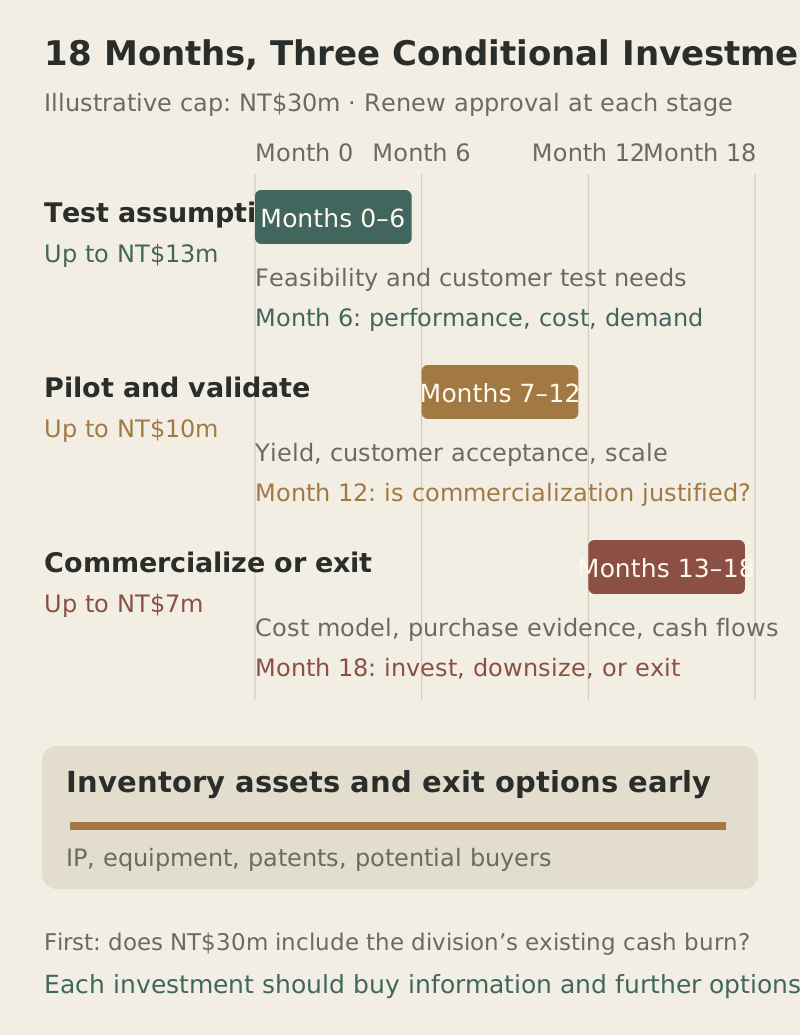
Figure 3 | NT$30 million is an illustrative ceiling, not an upfront spending commitment. At months 6, 12, and 18, review the evidence before deciding where the next capital allocation belongs.
If tests fail or future funding exceeds what the company can sustain, stop, downsize, or sell the relevant assets.
Preparing a technology sale cannot wait until the final three months. Inventory intellectual property, equipment, patents, and potential buyers early.
An important concept underlies this approach: real options.
Each limited investment should produce information as well as possible commercial results, preserving the right to invest in the next stage or exit.
But real options do not justify extending investment indefinitely. Waiting and keeping options open have costs.
And having enough money to keep investing does not make the investment worthwhile.
The real test, from the next decision point onward, is whether the expected value of new capital is better than its alternative uses.
Your father need not be dismissed as irrational for opposing closure.
You need not reject every transformation opportunity to prove your commitment to reform.
What you agree on is not guaranteed success. It is letting evidence determine where the next capital goes.
8. If Closure Becomes Necessary, How Should You Treat the People Left Behind?
Suppose eighteen months pass without enough technical or commercial evidence to support transformation.
You decide to propose closure to the board.
This time you bring more than a financial report.
You have plans for employees, ending supplier relationships, transferring customer service, and disposing of equipment and technology assets.
An Exit Plan: What Do You Need Beyond the Financials?
Stakeholder / asset | Specific arrangements |
|---|---|
Employees | Transfers, career and reemployment support; fulfill statutory severance, notice, and other obligations |
Suppliers | Review contracts, outstanding orders, and dedicated equipment; assess help with shifting capacity |
Customers | Arrange service and relationship transfers |
Equipment and technology | Inventory equipment, intellectual property, technical documents, and potential buyers |
Key people and knowledge | Assess adverse selection in exit offers and arrange knowledge transfer |
Some employees can move to other divisions; others need career counseling and reemployment support. Statutory severance, notice, and other obligations must be fulfilled under applicable law.
Some suppliers may have bought specialized equipment that is difficult to repurpose to serve your company.
Before ending orders, review contractual obligations, outstanding orders, and whether you can help them redeploy capacity or reach other customers.
In 1998, Jeffrey Dyer and Harbir Singh proposed the relational view: some competitive advantages reside not just within an organization but in specialized assets, knowledge exchange, and collaborative capabilities developed with other companies.
Ending a business may therefore dismantle years of collaboration, rather than merely terminate a contract.
A company cannot be expected to absorb all its partners' losses unconditionally.
But a reasonable transition, practical transfer support, and clear communication can reduce unnecessary harm.
A recent Microsoft initiative offers another reference point.
On October 26, 2026, Microsoft announced a Voluntary Exit Offer for certain eligible employees, providing financial support and career-planning resources under the program.
This does not mean all workforce adjustments are voluntary or prove that voluntary exits are always better than layoffs.
Voluntary programs can still produce adverse selection: the most capable employees, who can most easily find new jobs, may leave first.
Companies must still assess key talent, knowledge transfer, and whether the organization can operate after the adjustment.
For you, the central lesson is not to copy a large company's exit package.
It is to recognize that
a decision that improves company finances should not push every transition cost onto those with the least decision-making power.
Management responsibility includes efficient use of capital, honoring commitments, and reducing avoidable harm.
9. At the Final Board Meeting, What Should You Choose?
Eighteen months later, you and your father sit in the same conference room again.
This time, the discussion goes beyond whether to close the division he built.
You have prepared four options:
Continue operating, provided future cash flows justify the investment; downsize while preserving key customers and capabilities; find a buyer for the technology or business; or close completely and redeploy capital.
Each option has expected returns, risks, funding needs, and execution costs.
The Final Board Meeting: Compare Four Options on the Same Terms
Option | Core supporting evidence | Costs and risks to include |
|---|---|---|
Continue operating | Future cash flows justify additional investment | Continued losses, further funding, and opportunity cost |
Downsize | Key customers and technology retain value | Restructuring expenses and the cost of maintaining core capabilities |
Sell the technology or business | Transferable assets, buyers, and deal terms | Transaction time, integration, and transfer responsibilities |
Close completely | Overall value after exit exceeds the alternatives | Severance, contractual penalties, disposal, and lost customer networks |
Your father can still oppose your recommendation.
But his objection needs a business rationale that can withstand examination.
You can stand by your judgment.
But you must be willing to acknowledge that new evidence might prove your original conclusion wrong.
If agreement remains impossible, the governance body with formal authority should decide under applicable law, the company's constitution, and established procedures.
The Three-Circle Model separates family expectations from management authority.
Successor commitment helps explain why you take on the business and which motives affect your independent judgment.
Agency theory reminds us that even capable people who care deeply about the business can make choices that diverge from its long-term interests because of personal interests, past successes, and existing incentives.
These theories cannot decide whether to close the division for you.
They can keep the decision from becoming merely a struggle between father and son.
The hardest part of a family business has never been handing the title of chairman or CEO to the next generation.
It is whether, when generations reach different conclusions, the company still has a system for testing evidence, allocating authority, and bearing the consequences.
A family can hand a business to the next generation. It cannot make every judgment on that generation's behalf.
Assets, experience, and governance systems can be passed down.
Each generation must rebuild its ability to judge what deserves further investment and what to let go of in a new environment.
In the next article, we move from internal decision-making authority to the more fundamental question of ownership.
In 2011, the Hermès family used H51 to consolidate control. The same year, the Bulgari family chose to transfer control to LVMH.
Why did two luxury families with generations of history make different choices?
When a family controls a company's future, should it hold that power forever—or eventually learn to let it go?
Research and Further Reading
Family Business Governance
Tagiuri & Davis (1996) | Bivalent Attributes of the Family Firm: multiple roles and their dual effects in family businesses.
Sharma & Irving (2005) | Four Bases of Family Business Successor Commitment: four motives underlying successors' commitment.
Schulze et al. (2001) | Agency Relationships in Family Firms: Theory and Evidence: why agency costs persist under concentrated family ownership and management.
Capital Allocation and Decision Biases
Jensen & Meckling (1976) | Theory of the Firm: agency costs and ownership structure.
Amazon|1997 Shareholder Letter: Bezos on long-term investment and current operating indicators.
Amazon|2003 Form 10-K: operating income, net results, and cash flows for 2002–2003.
Harrigan & Porter (1983) | End-Game Strategies for Declining Industries: alternative competitive strategies in declining markets.
Staw (1976) | Knee-Deep in the Big Muddy: a classic experimental study of escalating commitment.
Graham, Harvey & Rajgopal (2005) | The Economic Implications of Corporate Financial Reporting: how short-term reporting targets affect real investment decisions.
Dyer & Singh (1998) | The Relational View: how companies jointly build competitive advantage.
Copeland & Tufano (2004) | A Real-World Way to Manage Real Options: managing uncertainty through staged investment.
Industry and Recent Company Data
Taiwan Textile and Apparel Export Statistics (2025)
Microsoft | Introducing a Voluntary Exit Offer (October 26, 2026)