

TAG STORY · JOURNAL
When Someone Wants Out of the Family Business, Who Pays for Their Shares?
The Tradeoffs of Control · Part 1
TAG Story ·
In spring 2011, Nicolas Puech, a fifth-generation heir to French luxury house Hermès, gave an interview at his estate in Andalusia, Spain.
The Hermès family was facing a challenge to control.
Luxury giant LVMH had acquired more than 20% of Hermès. In response to Bernard Arnault's growing position, family members were building a defense: pooling shares in a holding company, H51, to reduce the possibility of shares passing to outsiders.
By the end of 2011, H51 held approximately 50.15% of Hermès.
Nicolas Puech refused to join.
He did not oppose continued family control, nor had he publicly announced plans at the time to sell to LVMH.
His concern was whether concentrating shares within a holding structure also removed individual shareholders' freedom to decide.
In a March 2011 interview with France's Journal du Dimanche, he argued that respecting each family shareholder's freedom offered a better chance of preserving long-term unity. Other family members had a very different answer…
The disagreement exposes a question in family business succession that is rarely discussed publicly:
What happens when a family wants to own a business forever, but one member no longer wants to hold shares?
1. Valuable Shares Are Not Cash on Demand
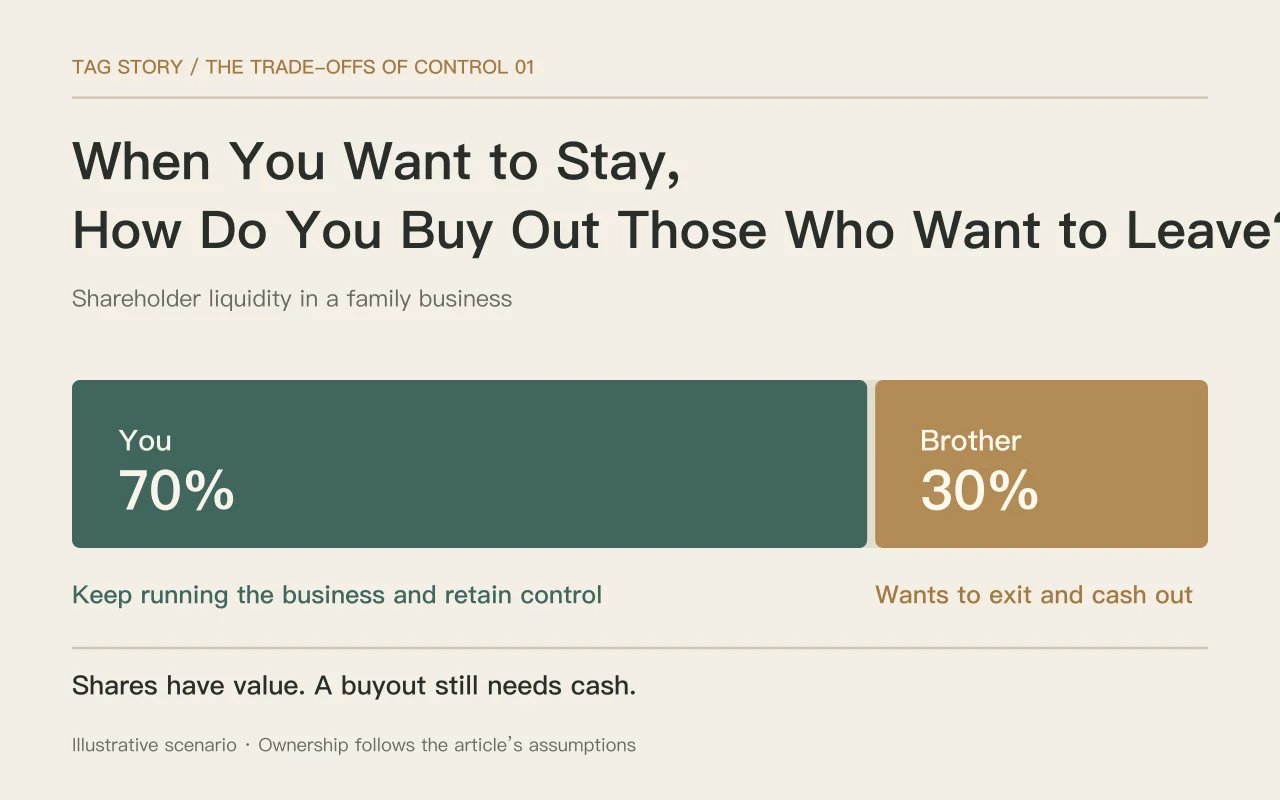
Imagine that you and your younger brother inherit your father's company.
You own 70% and take responsibility for daily operations. Your brother owns 30% but does not manage the business.
The company remains profitable, with an estimated total equity value of NT$1 billion.
One day, your brother says he wants to exit. He no longer wants the business's future operating risk and has a venture of his own to pursue.
On a proportional basis, his stake has a nominal value of NT$300 million. You want to preserve full family control, yet neither your personal resources nor the operating cash the company must retain can readily support that transaction.
There is the problem.
From your brother's perspective, he has a valuable but illiquid asset. Holding it means continuing to bear market risk, without necessarily participating in major decisions.
From your perspective, company funds are not personal savings. The business still needs to pay salaries, repay debt, replace equipment, and retain funds for future operations.
Burdening the company excessively to satisfy one shareholder's exit could ultimately harm every shareholder and employee.
Both needs are reasonable. They may not be simultaneously affordable.
This is the difficult shareholder liquidity problem (Shareholder Liquidity Problem)。
The operating value of a business and the cash a shareholder can obtain are different things.
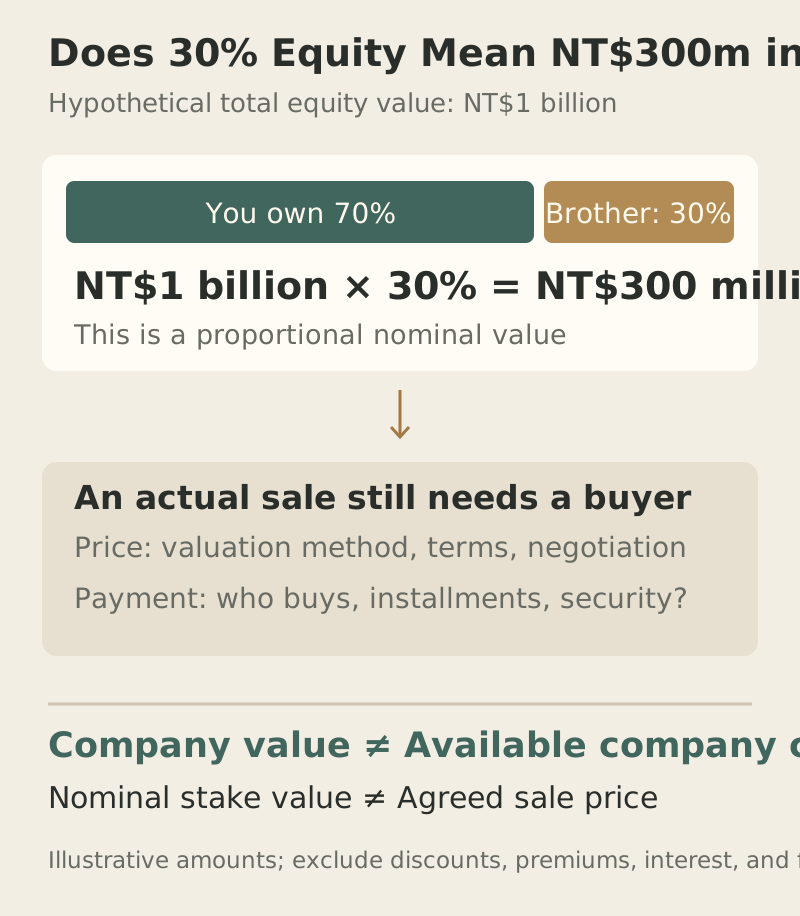
Figure 1: amounts are hypothetical. NT$300 million is a proportional nominal value; the actual transaction price still requires agreement.
2. Establish the Rights Before Debating Who Should Compromise
The least useful starting point is an immediate appeal to family feelings.
You might say, “This is the company our family left us. How can you sell?”
Your brother replies, “They are my shares. Why can't I sell?”
Both of you are focused on your rights without first establishing their legal basis together.
A more useful starting point is reviewing the company's existing governance arrangements with your brother.
If the shares were inherited, examine the will, trusts, articles of incorporation, and shareholder agreements, along with the enforceability of their provisions.
Separate Rights from Expectations First
Governance arrangement | What to establish | What cannot be assumed |
|---|---|---|
Transfer restrictions | Is there a legal or contractual basis? | A desire for permanent ownership does not create an unrestricted power to limit transfers. |
Right of first refusal | Can you buy before a sale to outsiders? | Having priority does not necessarily create an obligation to buy. |
Valuation and exit procedure | Who values the shares, and what procedures apply? | Without a prior arrangement, you cannot assume both sides have agreed. |
Family constitution | Which shared values and governance principles are recorded? | It does not necessarily bind share transfers. |
In Taiwan, ordinary companies limited by shares and close companies have different transfer rules. A wish to keep permanent family control does not itself allow a family to impose restrictions that did not previously exist.
More importantly:
a right of first refusal is not an obligation to buy.
You may have priority to acquire your brother's stake. Without a mandatory purchase provision, he cannot simply assume you must immediately pay the whole price.
Conversely, without a legal or contractual basis, you cannot require him to wait indefinitely.
Governance should provide a process for resolving conflicting interests, rather than guarantee one side permanent advantage.
3. Is a Family Buyout Necessarily Better?
As the person continuing to run the company, you might first consider buying the 30% yourself or arranging for other family members to buy it.
The reasons are straightforward.
First, avoid bringing in outside shareholders whose interests may differ before shareholder governance is mature.
Second, reduce the potential for new conflicts over board seats, voting rights, major investments, or future sales.
Third, use the restructuring to reconsider the family's long-term ownership arrangements.
For a steadily profitable company with immature governance, postponing nonessential expansion to address ownership may be reasonable.
But there is an often overlooked cost.
Suppose you and your brother agree on NT$300 million, payable by you in equal installments over five years.
Even without interest or transaction costs, that requires NT$60 million annually.
Where will it come from?
Comparing Acquisition Structures
Buyer | Funding source | First assess |
|---|---|---|
You personally | Your personal assets | Your financial capacity and ability to afford the payment schedule |
Family holding company | Holding-company financing | Loan terms, collateral, repayment sources, and debt risk |
If repayment depends on future company dividends, assess whether the dividend policy would squeeze the reinvestment the operating company needs.
There is a further question worth asking:
When you already own 70%, how much should you pay to reach 100%?
If current governance already gives you primary control, the additional control gained from the remaining 30% may not be worth its purchase price.
Full ownership may reduce future shareholder conflicts and transaction costs. Those benefits are real, but cannot be assumed priceless.
If a buyout causes an irretrievable market opportunity to be missed or imposes excessive borrowing risk on the family, preserving every share may damage those shares' long-term value.
A family buyout deserves consideration if you can afford the corresponding costs.
Control is worth protecting. It still needs a reasonable price.
4. A Mature Family Does Not Wait for an Exit Request to Find the Money
The International Finance Corporation (IFC), part of the World Bank Group, discusses family shareholding policies in its Family Business Governance Handbook.
As generations multiply and ownership disperses, many members hold increasingly small stakes.
Some work in the business and earn salaries. Others do not participate in management and receive returns only through dividends.
If the company pays no dividends over a long period and offers no reasonable exit, nonoperating shareholders may become dissatisfied.
The IFC therefore recommends planning liquidity mechanisms in advance. It describes a Shares Redemption Fund: allocating part of annual profits to prepare for potential future exits.
This is not a requirement that every family business establish a company-funded buyback pool. The purchasing entity, allocation, and buyback method must comply with local law. Taiwan's Company Act, Article 167, for example, generally restricts a company's purchase of its own shares, subject to statutory exceptions.
The underlying governance principle is worth studying:
when exit needs are foreseeable, they should not depend entirely on last-minute negotiation.
In 2021, Claudia Binz Astrachan and colleagues published research on family shareholder agreements in the Journal of Family Business Strategy, introducing the concept of Family-Practice Fit.
They argue that governance arrangements need to fit a family's own objectives, values, and development stage, rather than copy the rules of another successful family.
This is conceptual research, not an empirical guarantee of any particular system's performance. It offers a useful way to examine the problem.
Families should answer at least these questions in advance:
Put Three Things in Writing Before an Exit
Issue | What to agree | Problem addressed |
|---|---|---|
Who can buy? | The scope of family purchase priority and when outside shareholders may enter | Who can become a future co-owner |
How is the price set? | Valuers, independent appraisals, liquidity discounts, and control premiums | How buyer and seller reach an acceptable price |
How is it paid? | Installments, security, and the next exit mechanism if the family cannot buy | An executable source of funding for the exit |
Operating and nonoperating shareholders also need reasonable disclosure, dividend policies, and dispute procedures.
People without information often find it harder to trust decisions that require them to keep waiting.
Ideally, establish these rules before the older generation hands over. Do not wait for siblings to argue and let the largest shareholder set them then.
5. Can a Friendly Investor Solve the Problem?
If the family truly cannot buy, an outside investor is an option.
Being a friend today does not guarantee being an ally forever.
Gucci's history offers an instructive case.
In 1988, Bahrain-based Investcorp publicly confirmed that it had acquired close to half of Gucci from several family members.
It said it hoped to maintain a stable, long-term relationship with the other shareholders and management.
In 1993, Investcorp acquired Maurizio Gucci's remaining 50%, and the family ultimately left ownership of the original business.
That does not establish that Investcorp broke a promise. Gucci also faced complex family disputes and operating problems.
The lesson is that an equity transaction changes future bargaining positions. Today's partnership does not guarantee a permanent ownership structure.
If you bring in an outside shareholder, examining their funding and business background is only a beginning.
Outside Shareholders: Turn the Relationship into Specific Terms
Agreement area | What to settle first |
|---|---|
Board representation | Which board seats will the investor receive? |
Vetoes on major matters | Which major decisions need their approval? |
Information rights | What information can they obtain? |
Transfer conditions | To whom may they transfer shares, and through which process? |
Exit arrangements | How will shares and payment be handled when they want to exit? |
Selling shares to a third party is a secondary sale of existing equity. It does not automatically bring new growth capital into the company.
Solving your brother's liquidity problem and raising money for the business are different transactions.
6. Succession Should Leave Choices for Those Who Stay and Those Who Leave
Return to the opening scenario.
If you ultimately buy your brother's 30%, the transaction should achieve at least three things:
Your brother independently assesses the sale, understands the shareholder rights he gives up, and accepts the terms without improper pressure.
You find affordable financing, preserving the business's financial health rather than putting it in difficulty to reach 100% ownership.
You and the family use the experience to establish a process for the future, reducing the chance of the same dispute recurring in the next generation.
Completing the sale does not require your brother to leave the family. If both sides want to work together and a suitable role exists, he might even remain employed by the company—without participating as a shareholder.
Family membership, business ownership, and a management position are different roles.
If you buy your brother's entire 30%, how do the three roles change?
Role | You | Your younger brother |
|---|---|---|
Family member | Remain a family member | Remain a family member |
Business shareholder | Ownership rises from 70% to 100% | No longer holds company shares |
Company position | Continue running daily operations | Employment depends separately on mutual willingness and an appropriate role |
A company may carry generations of wealth, memories, and values. Descendants need not share the same life goals or willingness to bear risk.
We cannot demand that every heir make running the family business a lifelong mission.
Nor can a company be expected to sacrifice long-term development unconditionally for every individual's needs.
Mature governance lets different choices coexist under fair, executable arrangements, rather than requiring everyone to own the same assets forever.
Nicolas Puech's objection leaves a difficult question:
When a family limits individual choice for the common good, is it protecting the inheritance—or accumulating future conflict?
In the next article, we will return to Hermès, examine H51's ownership defense, and ask what the family is willing to give up to preserve independence.
Research and Further Reading
Hermès: 2011 company announcement and H51 ownership arrangements.
IFC: Family Business Governance Handbook, shareholding policies and liquidity mechanisms, page 28.
Binz Astrachan et al.(2021)|Addressing the Theory-Practice Divide in Family Business Research
Gucci Group: 2004 annual report filed with the US SEC, corporate history.
Reuters / Los Angeles Times: Investcorp's public statement on its Gucci investment, 1988.
Taiwan Company Act: Laws & Regulations Database, Articles 163, 167, and 356-5.